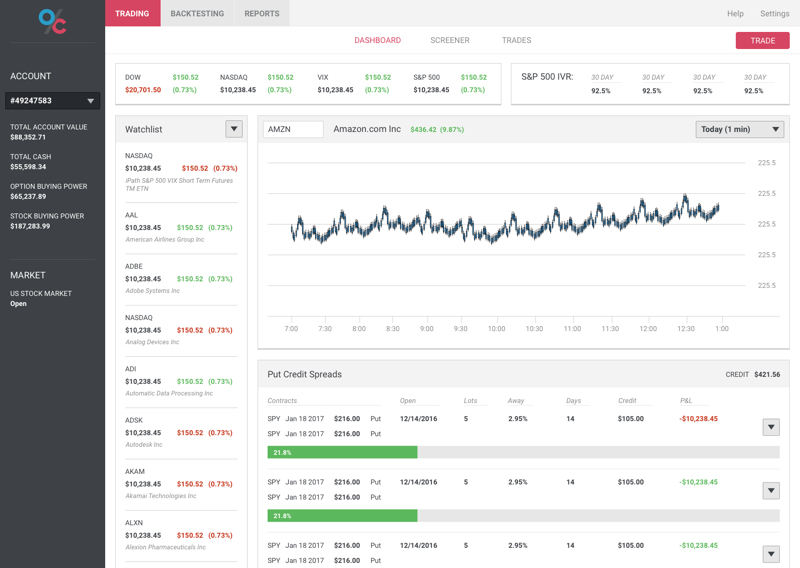
If you've been searching for a reliable way to generate income from the stock market, you've probably stumbled across the cash secured puts strategy. Unlike most trading approaches that feel like gambling, selling cash secured puts is methodical, predictable, and when done right, surprisingly consistent. I know because I've been doing it for years—and my documented results show over $27,000 in income from this exact approach.
This isn't theory. This isn't what some textbook says should work. This is what actually works, backed by real trades I've made and shared on Options Cafe.
What Are Cash Secured Puts?
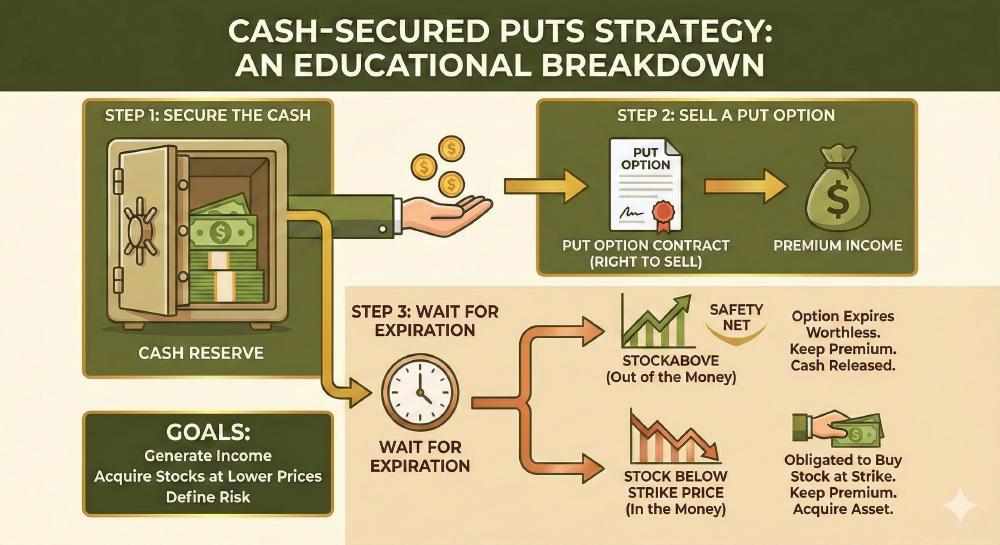
Let's cut through the jargon. A cash secured put is when you sell someone the right to sell you 100 shares of stock at a specific price (the strike price) by a specific date (the expiration). In exchange for taking on this obligation, you collect a premium upfront—that's your income.
The "cash secured" part means you have the cash in your account to buy those 100 shares if needed. You're not using margin or leverage. If the stock drops below your strike price and you get assigned, you simply buy the shares at the price you already agreed to.
Here's a simple example:
- Stock XYZ is trading at $50
- You sell a $45 put expiring in 30 days
- You collect $1.50 per share ($150 total)
- You set aside $4,500 in cash (45 × 100 shares)
Now one of two things happens:
Scenario 1: The stock stays above $45 by expiration. Your put expires worthless. You keep the $150 premium and your $4,500 cash is freed up to do it again. That's a 3.3% return in 30 days.
Scenario 2: The stock drops below $45. You're assigned and buy 100 shares at $45 each. But remember, you collected $1.50 per share in premium, so your actual cost basis is $43.50—a 13% discount from where the stock was trading when you sold the put.
Either outcome is acceptable. That's the beauty of this strategy.
Why Sell Puts for Income?
I've tried dozens of trading strategies over the years. Day trading, swing trading, buying calls, buying puts—you name it, I've probably lost money on it at some point. But selling puts changed everything for me. Here's why:
1. Time Works FOR You, Not Against You
When you buy options, time decay (theta) is your enemy. Every day that passes, your option loses value. When you sell options, time decay is your friend. Every day that passes, the option you sold loses value, which means you make money.
This is a fundamental edge that most retail traders overlook. They chase the lottery-ticket potential of buying options while professional traders quietly collect premiums day after day.
2. You Don't Need to Be Right About Direction
When you buy a call, you need the stock to go up. When you buy a put, you need it to go down. But when you sell a cash secured put, you make money if the stock goes up, stays flat, or even drops a little. You only lose if the stock drops significantly below your strike price.
Think about that. Three out of four market scenarios are profitable for you.
3. You Get Paid to Place Limit Orders
Ever set a limit order to buy a stock at a lower price and just... waited? With cash secured puts, you get paid to wait. Instead of hoping the stock drops to your price, you collect premium while you wait. If it never drops, you keep the premium. If it does drop, you get the shares at an even better price than your strike (because of the premium you collected).
4. The Math Actually Works
Over time, selling options has a mathematical edge because of volatility risk premium. Options are priced based on expected volatility, but actual volatility is usually lower than expected. This means option sellers consistently collect more premium than they should based on actual stock movements.
Step-by-Step: How to Sell a Cash Secured Put
Let me walk you through exactly how I execute this strategy. This is the same process I use for every trade.
Step 1: Select Your Stock
This is the most important step. You need to choose stocks you'd actually want to own at the strike price you select. This isn't about finding the highest premium—it's about finding quality companies at attractive prices.
My criteria for stock selection:
- Strong fundamentals: Profitable, growing revenue, manageable debt
- Liquid options market: Tight bid-ask spreads, high open interest
- Stock price you can afford: Remember, one contract = 100 shares
- A company you understand: If you can't explain what they do, skip it
- No upcoming earnings or major events: Unless you specifically want that volatility
I have a separate guide on selecting the best stocks for the wheel strategy that goes deeper on this topic.
Step 2: Choose Your Strike Price
The strike price is where you're willing to buy the stock if assigned. I typically select strikes that are:
- 5-15% below the current stock price: This gives you a margin of safety
- At or below key support levels: Technical analysis can help here
- At a price representing good value: Would you happily buy at this price?
The further out-of-the-money you go, the lower your premium but the higher your probability of success. I aim for strikes with a 70-85% probability of expiring worthless (delta between 0.15 and 0.30).
Step 3: Select Your Expiration Date
Time decay isn't linear—it accelerates as expiration approaches. The sweet spot for premium collection is typically 30-45 days until expiration. This gives you:
- Enough premium to make the trade worthwhile
- Accelerating time decay working in your favor
- Time to adjust if things go wrong
- Frequent opportunities to compound your returns
I rarely go beyond 45 days or below 21 days. Too long and your capital is tied up inefficiently. Too short and the premium doesn't justify the risk.
Step 4: Calculate Your Cash Requirement
Your broker will require you to have cash equal to the strike price times 100 shares. For a $50 strike put, you need $5,000 in cash secured in your account.
Cash Required = Strike Price × 100
This is non-negotiable for cash secured puts. If you don't have the cash, you're trading on margin (naked puts), which is a different strategy with different risks.
Step 5: Place Your Trade
When placing the order:
- Use limit orders: Never market orders for options
- Start at the mid-price: Halfway between bid and ask
- Be patient: It's okay to wait for your price
- Check the bid-ask spread: Wide spreads mean harder fills and worse pricing
In your brokerage platform, you'll select "Sell to Open" for a put option. Your order will look something like: "Sell to Open 1 XYZ $45 Put expiring Feb 21 at $1.50 Limit."
Step 6: Manage the Position
After you open the trade, you're not done. Position management separates profitable traders from struggling ones.
If the stock stays above your strike: Let time decay work. As expiration approaches, your put will lose value. You can either let it expire worthless or buy it back for a profit.
If the stock drops toward your strike: You have options. You can:
- Do nothing: Accept assignment and own the shares
- Roll out: Buy back your put and sell a new one at the same strike but later expiration (collecting more premium)
- Roll down and out: Buy back and sell a new put at a lower strike and later expiration
- Close for a loss: If your thesis has changed, cut your losses
My Real Results: $27,000+ in Put Selling Income
I don't believe in sharing strategies without receipts. Here's what my actual trading results look like.
Through consistent application of the cash secured puts strategy as part of my wheel strategy approach, I've documented over $27,000 in premium income. This didn't happen overnight—it's the result of placing trade after trade, month after month, following the exact process I've outlined above.
Some key stats from my trading:
- Win rate: Approximately 80% of my cash secured puts expire worthless or are closed for profit
- Average return per trade: 2-4% on capital at risk over 30-45 days
- Assignment rate: About 20% of my puts result in stock ownership (which is fine—that's the plan)
- Annualized return: Varies by market conditions, but consistently outperforms buy-and-hold
The key insight from my experience: consistency beats home runs. I'm not looking for 100% returns on a single trade. I'm looking for 2-3% returns, twelve times a year, compounding over time.
Risk Management for Cash Secured Puts
Let's be clear: cash secured puts have real risk. The maximum loss is substantial—if a stock goes to zero, you lose your entire cash secured amount minus the premium collected. Risk management isn't optional; it's essential.
Position Sizing: The 5% Rule
Never put more than 5% of your portfolio at risk on a single position. This means if you have a $100,000 account, the maximum cash secured for any single put should be $5,000.
Some traders push this to 10% for high-conviction trades, but I've found 5% lets me sleep at night and stay in the game long enough for the strategy to work.
Portfolio Diversification
Don't sell puts on correlated stocks. If you have cash secured puts on Apple, Microsoft, and Google, a tech selloff hurts all three positions simultaneously. Spread your trades across different sectors.
Cash Reserve
Keep 20-30% of your portfolio in cash at all times. This serves two purposes:
- Opportunity capital: When great setups appear, you can act
- Safety buffer: If multiple positions move against you, you have room to maneuver
Know When to Cut Losses
If a stock drops 20-30% below your strike, something is seriously wrong. At some point, it's better to buy back your put at a loss than to own a falling knife. I typically set mental stops at 200% of the premium collected.
For example, if I collected $150 in premium, I'll close the position if the put value hits $450 (a $300 loss). This prevents small problems from becoming catastrophic.
When to Close or Roll Your Puts
One of the most common questions I get: should I let puts expire or close them early?
Close Early When:
- You've captured 50-70% of the premium: Why risk the remaining 30% for time in the market?
- A better opportunity appears: Close the current trade and redeploy capital
- Your thesis has changed: New information suggests the stock is riskier than you thought
- You're approaching earnings or ex-dividend dates: Unless you want that exposure
Roll When:
- The stock is approaching your strike and you want more time: Roll out for a credit
- You still believe in the stock but want a lower strike: Roll down and out
- You can collect additional premium that justifies the added time: Always calculate the return
Let It Expire When:
- The stock is well above your strike (3+ days out): No risk of assignment
- Closing costs more than it's worth: If the put is trading at $0.05, just let it expire
Tax Implications of Selling Puts
I'm not a tax advisor, but here's what you need to know to have an informed conversation with yours:
Premium Income: When a put expires worthless, the premium you collected is a short-term capital gain, taxed at your ordinary income rate.
Assignment: If you're assigned shares, the premium you collected reduces your cost basis. This affects your future capital gains when you sell the shares.
Closing a Put: If you buy back a put you sold, the difference between what you received and what you paid is a capital gain or loss. Held less than a year = short-term.
Wash Sales: Be careful closing losing puts and immediately selling new puts on the same stock. Wash sale rules may defer your loss.
Keep meticulous records. Your broker provides 1099s, but having your own spreadsheet makes tax time much easier.
Cash Secured Puts as Part of the Wheel Strategy
Cash secured puts are the first half of my favorite income strategy: the wheel strategy. Here's how they fit together:
- Sell cash secured puts on a stock you want to own
- Collect premium while waiting for assignment
- If assigned, own the shares at a discount (strike minus premium)
- Sell covered calls against your shares to collect more premium
- If called away, the cycle restarts with selling puts again
The wheel keeps generating income whether you own shares or not. It's a perpetual motion machine for options premium, and cash secured puts are the entry point.
Common Mistakes to Avoid
I've made all of these mistakes so you don't have to:
1. Chasing High Premium
That biotech stock with 15% premium looks tempting until it gaps down 40% on a failed drug trial. High premium = high risk. The market isn't dumb—if premiums are unusually rich, there's a reason.
2. Selling Puts on Stocks You Don't Want to Own
"But the premium was so good!" Famous last words. If you wouldn't buy the stock at your strike price, don't sell the put. Period.
3. Ignoring Earnings Dates
Selling puts through earnings is playing with fire unless you specifically want that volatility exposure. Stocks can move 10-20% on earnings, and all those probabilities go out the window.
4. Over-Concentrating in One Sector
In 2022, I saw traders blow up their accounts by having puts on multiple tech stocks when the sector sold off. Diversification isn't just for stock portfolios.
5. Never Taking Profits
Greed kills returns. When you've captured 60% of the premium with weeks to go, close the trade and move on. That extra 40% isn't worth the assignment risk.
6. Trading Too Large
One bad trade shouldn't ruin your year. If a single position can hurt you badly, you're trading too large. Reduce position sizes until a total loss on any single trade feels like a minor inconvenience.
Getting Started: Your First Cash Secured Put
Ready to try this yourself? Here's my recommended approach for beginners:
- Start with a stock you already own or follow closely: You need conviction
- Choose a strike 10-15% below current price: Give yourself room
- Select 30-45 days to expiration: The sweet spot for premium decay
- Use a position size that makes you comfortable: Smaller than you think
- Set a profit target of 50% of premium collected: Take profits early
- Have a plan if the stock drops: Roll, close, or accept assignment?
Your first few trades are about learning, not earning. Keep position sizes small until the process feels natural.
Frequently Asked Questions
How much money do I need to start selling cash secured puts?
It depends on the stock prices you're targeting. For a $50 stock, you need $5,000 per contract. For lower-priced stocks in the $20-30 range, you can start with $2,000-3,000 per position. I recommend at least $10,000 in total account value to allow for proper diversification.
What's the difference between cash secured puts and naked puts?
Cash secured puts require you to have the full cash amount to buy shares if assigned. Naked puts use margin, meaning you don't have all the cash on hand. Naked puts amplify both gains and losses and require higher option approval levels from your broker.
Can I sell cash secured puts in an IRA?
Yes! Most brokers allow cash secured puts in IRAs. This is actually a great way to use the strategy since your gains grow tax-deferred. You cannot use margin in an IRA, so all puts must be fully cash secured anyway.
What delta should I target?
I typically target puts with a delta between 0.15 and 0.30. This translates to roughly a 70-85% probability of expiring worthless. Higher delta = more premium but higher assignment probability. Find the balance that fits your goals.
How do I handle assignment?
Assignment isn't a failure—it's part of the strategy. If you're assigned, you now own shares at a discount. Your next move is to sell covered calls against those shares, collecting more premium while waiting for the stock to recover.
Is selling puts better than just buying stocks?
Neither is universally "better." Selling puts generates income in flat or rising markets and provides a discount when buying shares. Buying stocks outright gives you full upside participation. The best approach depends on your market outlook, income needs, and risk tolerance.
Final Thoughts
Cash secured puts changed how I think about investing. Instead of hoping stocks go up, I get paid to wait for prices I like. Instead of timing the market, I collect premiums while the market does its thing. Instead of gambling on direction, I stack probability in my favor.
The strategy isn't sexy. There are no 10-baggers, no overnight riches, no "one weird trick" that Wall Street hates. Just consistent, documented income from selling options premium.
My $27,000+ in documented returns didn't come from one lucky trade. It came from dozens of boring, predictable trades executed over time. If that sounds good to you, welcome to the right side of the options market.
— Spicer
Want to see my actual trades? Browse my trading history on Options Cafe, and consider joining the course to get real-time alerts when I open new positions.
Related Topics: Cash Secured Puts, Cash Secured Puts Strategy, Selling Puts for Income, How to Sell Puts, Put Selling Strategy, Options Income, Wheel Strategy, Premium Selling, Options Trading, Income Generation