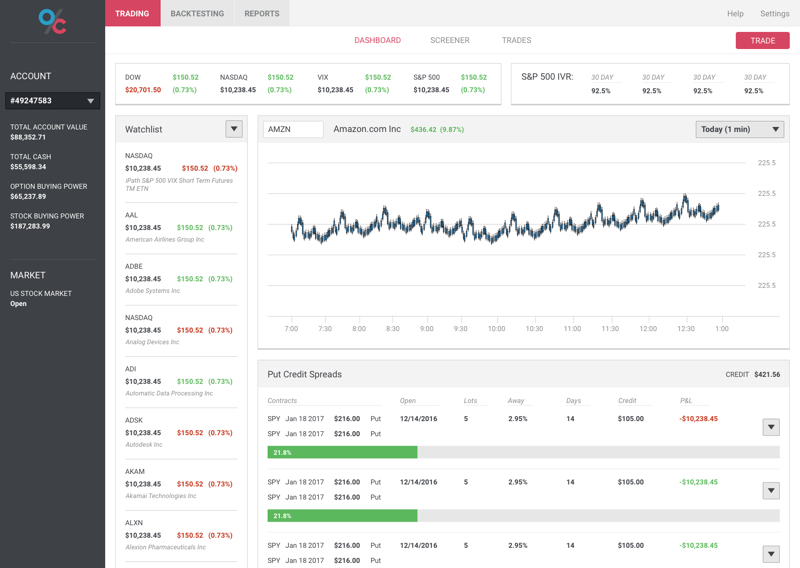
If you are searching for the best options alert service, you have probably noticed that every one of them claims a high win rate and happy members. I run an alert service myself, so I am biased, and I will say that up front. Below are the eight checks I would run before paying anyone for options trade alerts, including me. Every trade I place is documented in the open, so you can hold me to the same list.
What an Options Alert Service Actually Does
An options alert service sends you a trade when the person running it places one. A useful alert has everything you need to copy it: the underlying, the strategy, the strikes, the expiration, and the price. A good service also tells you when it closes, rolls, or gets assigned, so you see the whole life of the trade and not just the exciting entry.
Most services fall into one of four groups:
- Premium-selling income alerts. Cash-secured puts, covered calls, credit spreads. Slower trades, held for days or weeks.
- Directional swing alerts. Buying calls or puts on a view of where a stock is going. Bigger wins, more frequent losses.
- 0-DTE and intraday alerts. Trades that open and close the same day. You need to be at a screen when they go out.
- Flow alerts. Feeds of unusual options activity. These are market data, not trades someone actually placed.
Knowing which group a service is in tells you more than any win rate on its sales page.
What Options Alert Services Cost
Almost every options alert service is a monthly subscription. Prices commonly run from about $30 to $300 a month. The monthly number looks small. The number that matters is what you pay over the years you actually use it:
On a $10,000 account, a $100-a-month service has to earn you 12% a year before you have made a dollar. That is a high bar for any strategy. I charge once because I am a trader who publishes what I am doing, not a signal business, and sending the alerts costs me nothing extra.
8 Checks Before You Pay for Options Trade Alerts
1. Does it publish every trade, including the losers?
This is the check that rules out most services. A screenshot of a winning trade proves nothing. A full list of every trade, with dates, prices and results, proves a lot. If you cannot find the losing trades, assume they are being hidden. I publish every trade by year on my results pages, wins and losses.
2. Is it real money or a "model portfolio"?
Paper trades always fill at the price the alert says. Real trades do not. Ask whether the person sending the alerts places the same trade in their own account, at the same time, at a size that matters to them. If the answer is vague, it is probably a model.
3. Can you see the full history before you pay?
A service that shows its track record only to paying members is asking you to buy first and check later. The record should be public, and it should go back years, not weeks. A track record that quietly restarts every January is a red flag.
4. Does the strategy fit your account and your day?
0-DTE alerts are useless if you are at work when they go out. Wheel alerts on $70 stocks need about $7,000 per position. Before you look at results, ask whether you could actually take the trades. My guide to the wheel with a small account covers the sizing side of this.
5. How big are the losses, not just how often you win?
A high win rate is the easiest number to sell and the easiest to misread. My 0-DTE SPX iron butterflies won 77% of the time in 2024 and made $5,079. They won 78% of the time in 2025 and lost $5,472. Same win rate, opposite result, because the losing trades got bigger. Ask any service for its average win and its average loss.
6. What does it cost over three years?
Use the table above. Multiply the monthly price by 36 and compare that to what the strategy could realistically earn on your account. If the subscription eats most of the expected profit, the only sure winner is the person selling it.
7. Does it teach you the rules, or keep you dependent?
An alert tells you what to do today. Rules tell you what to do when the alerts stop, or when a trade goes wrong and you have to decide whether to roll or take the loss. A service worth paying for explains why each trade was placed, so that over time you need it less. My alerts come with my course for exactly that reason.
8. How do alerts arrive, and how fast?
Email, text, app push, or a chat room. For slow income trades, a few minutes of delay does not matter. For 0-DTE trades, it can be the whole edge. Match the delivery to the strategy, and ask what happens when you miss an alert.
Red Flags to Walk Away From
- Income promises, or phrases like "replace your paycheck" or "1,000% returns".
- Only winning trades shown, usually as screenshots.
- No way to see the full trade history before paying.
- An anonymous trader with no name and no history you can check.
- A track record that resets every year or skips the bad months.
- Upsells to a "VIP" tier where the real trades supposedly live.
How My Alerts Measure Up
Fair is fair, so here is my own service against the same list. Every trade is published, including the 2025 year where my iron butterflies lost money. Every alert is a real trade in my own account. The full history is public before you pay. The price is one payment of $150, with no monthly fee, and it includes my course.
It is not perfect for everyone. Alerts are email only, with no app or text messages. I cover three strategies: the wheel, SPY put credit spreads, and 0-DTE SPX iron butterflies, and the butterflies have been quiet since late 2025 after that losing year. If you want fast directional or day-trading alerts, mine are the wrong fit, and that is fine.
Options Alert Service FAQ
Are options alert services worth it?
How much do options alert services cost?
What is the difference between options alerts and options signals?
Are trade alerts financial advice?
Can you lose money following options alerts?
Whatever you choose, run these eight checks first. A service that passes them is rare. A service that fails them will usually cost you more than the subscription price.
Related Topics: Options Alert Service, Best Options Alert Service, Options Alert Services, Options Trading Alerts, Options Trade Alerts, Options Trading Signals, Trade Alert Subscription, Options Alerts