Almost every article about options trading mistakes is written in the abstract. "Don't overleverage." "Manage your risk." "Avoid earnings." Fine advice, and completely forgettable, because nobody attaches a number to it.
I'm going to attach numbers. Every loss below is a real trade from my own log, and every one of them is already published—I post my losers alongside my winners, which is the only way any of this is worth reading. These are the ten mistakes that cost me the most, what each one actually cost, and the rule I changed afterward.
The Ten Mistakes, and What Each One Cost
Here's the whole list up front, so you can jump to whichever one you're currently making.
| # | Mistake | What It Cost |
|---|---|---|
| 1 | Judging a strategy by win rate | A $10,558 swing year over year |
| 2 | Letting two trades erase a year | −$5,698 over two months |
| 3 | Chasing premium on a company I didn't understand | −$1,124 |
| 4 | Wheeling something that can't recover | −$595 |
| 5 | Owning the same risk under ten tickers | −$1,519 in one month |
| 6 | Selling puts through earnings | −$680 in one night |
| 7 | Oversizing a single position | −$1,028 and −$951 |
| 8 | Wheeling a stock with no reason to rise | −$516 |
| 9 | Going quiet after a drawdown | Missed months of recovery |
| 10 | Running a strategy through the wrong regime | −$5,381 in one month |
1. Judging a Strategy by Its Win Rate
This is the most expensive lesson on the list, and it's the one almost nobody talks about, because a high win rate feels like proof you know what you're doing.
Here are two years of my zero DTE SPX iron butterfly strategy, straight from the log:
| Year | Trades | Win Rate | Profit |
|---|---|---|---|
| 2024 | 168 | 77% | +$5,079 |
| 2025 | 86 | 78% | −$5,472 |
Read that again. The win rate went up and the strategy went from making five grand to losing five grand. Nothing about "78% of my trades are winners" tells you whether you're making money.
What changed was the size of the losses. When you sell premium, your wins are capped and your losses are not. A 78% win rate with losers three times larger than your winners is a losing strategy that feels like a winning one right up until you check the balance.
The rule I changed: I track expectancy—average win times win rate, minus average loss times loss rate—not win percentage. Win rate is the number you show people. Expectancy is the number that pays you.
The math is worth doing by hand once, because it's genuinely counterintuitive. Say you win 80% of the time for $100 and lose 20% of the time for $500:
(0.80 × $100) − (0.20 × $500) = $80 − $100 = −$20 per trade
Eighty percent winners and you lose money on every trade you place. Run that a hundred times and you're down two grand while telling everyone you have an 80% win rate. Both statements are true.
This is the specific reason premium selling attracts people and then hurts them. The structure hands you a high win rate for free—most options expire worthless, so most of your trades win. That high number is a property of the structure, not evidence of skill. The skill is entirely in what happens on the 20% of trades that go wrong.
2. Letting Two Trades Erase a Year
March and April of 2025 were the worst stretch my SPY put credit spread strategy has ever had. Here's what the log shows:
- March 2025: 3 trades, 2 wins, 1 loss — −$1,793
- April 2025: 5 trades, 3 wins, 2 losses — −$3,904
April had more winners than losers and still lost nearly four thousand dollars. Three winning trades were not enough to cover two losing ones. That is what an uncapped loss looks like when you haven't decided in advance where you get out.
The tariff headlines that spring produced the kind of gap moves that blow through a spread before you can react. I've written the full account of that period in my post on trading through drawdowns.
The rule I changed: I set a maximum loss per trade as a multiple of the credit received, and I honor it mechanically. The strategy finished 2025 at +$3,259 because every month from May through December was positive. The recovery was never in doubt—the size of those two months was the problem.
3. Chasing Premium on a Company I Didn't Understand
BMNR is a bitcoin treasury company. The options premiums were enormous, which is exactly what attracted me, and enormous premium is the market telling you something you should probably listen to.
November 2025: 3 trades, −$1,124.
I could not tell you what a fair price for that stock was. I had no framework for deciding whether a strike was too close or too far, because I had no view on the underlying business at all. I was pricing volatility and pretending it was analysis.
The rule I changed: If I can't explain in two sentences why I'd be content owning the stock for a year, I don't sell a put on it. My stock selection process is now a hard filter, not a suggestion.
4. Wheeling Something That Can't Recover
UNG is a natural gas fund. December 2025: 2 trades, −$595.
The wheel strategy has a built-in safety net: if you get assigned, you own a good company and you sell calls against it until it recovers. That net depends entirely on the word "recovers."
A commodity fund like UNG doesn't have earnings, a management team, or a reason to trend up over time. It has structural decay from rolling futures contracts. Getting assigned on a stock means owning a business. Getting assigned on UNG means owning a slow leak.
The rule I changed: I wheel companies, not commodity funds. If the underlying has no mechanism by which it becomes more valuable, the assignment fallback isn't a fallback.
5. Owning the Same Risk Under Ten Different Tickers
January 2026 was my worst month in the wheel: −$1,519 across 19 trades. Here's how the damage was spread:
| Symbol | Loss |
|---|---|
| DKNG | −$1,028 |
| IONQ | −$973 |
| RIVN | −$789 |
| SOFI | −$485 |
| RKLB | −$301 |
| RKT | −$249 |
Six different tickers across gambling, quantum computing, EVs, fintech, space, and mortgages. On paper that's a diversified book. In practice every one of them is a high-beta growth name that trades on risk appetite, and when risk appetite turned in January they all went down together.
I thought I was diversified because I had spread across sectors. I wasn't. I owned one position—"speculative growth"—in six costumes.
The rule I changed: I cap how much of the book sits in high-beta names regardless of sector labels. Diversification means owning things that respond differently to the same news, not things with different SIC codes.
Practically, I now sort candidates into buckets by what actually drives them, and limit exposure per bucket rather than per sector:
| Bucket | What Actually Moves It | Examples From My Log |
|---|---|---|
| Speculative growth | Risk appetite, rates | IONQ, RIVN, RKLB, QBTS |
| Consumer fintech | Credit conditions, rates | SOFI, AFRM, HOOD, RKT |
| Established profitable | Company fundamentals | NKE, AKAM, ETSY, CHWY |
| Crypto-linked | Bitcoin price | BMNR, IBIT |
In January 2026, five of my six losing positions came from the top two rows. The buckets make that concentration visible before the month happens instead of after.
6. Selling Puts Through Earnings
INTC, August 2024. One trade, −$680.
Earnings are the one event where implied volatility is high for an honest reason: the stock genuinely might gap 15% overnight. Selling a put into that is not collecting a risk premium, it's making a directional bet with a capped upside and an ugly downside.
The premium looked great. It always does before earnings. That's the entire trap.
The rule I changed: I close or roll past any position with earnings inside the expiration window. Skipping one cycle costs a few dollars of premium. Not skipping it cost me $680 in a single night.
It's worth understanding why the premium is elevated in the first place. Before earnings, implied volatility rises because the market genuinely doesn't know what's coming. After the announcement, that uncertainty resolves and IV collapses—the effect known as IV crush.
Sellers love this setup because IV crush works in their favor: the option loses value fast the morning after. And it does work, most of the time. The problem is the distribution. You collect a modest extra credit in exchange for accepting a small chance of a very large gap against you.
That's mistake #1 in miniature. High win rate, terrible expectancy. Nine earnings cycles go fine and pay you an extra $40 each. The tenth one takes $680, and you've spent nine months of edge on a single night.
7. Oversizing a Single Position
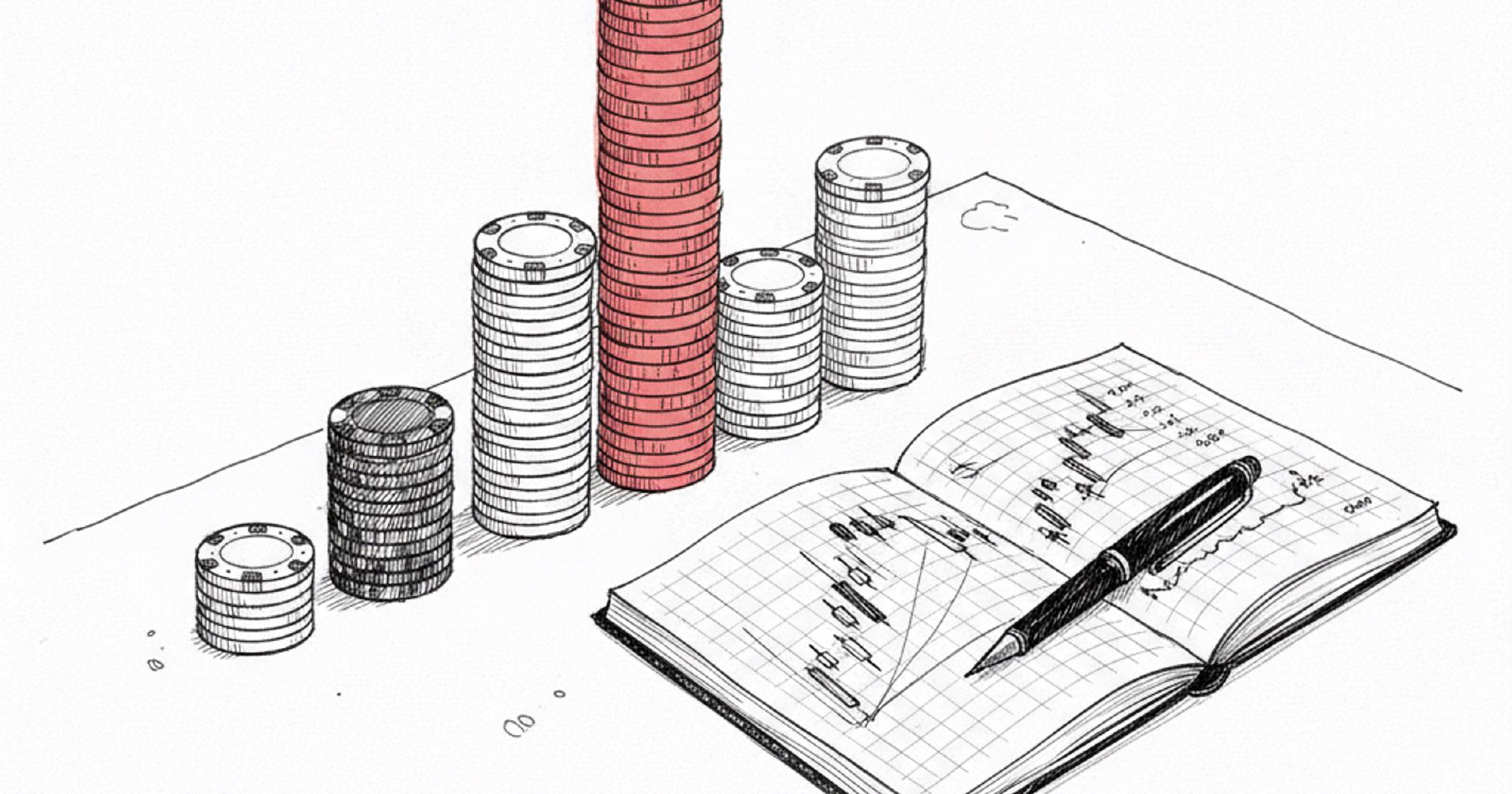
Two single trades, two large holes:
- DKNG, January 2026: one trade, −$1,028
- RKT, February 2026: one trade, −$951
Neither of those was a bad idea. Both were bad sizes. A single position should never be able to define the month, and both of those did—February 2026 still finished at +$2,607, but it would have been meaningfully better without one oversized bet.
Sizing is the only variable you fully control. You cannot control whether the stock drops. You can absolutely control whether that drop matters.
The rule I changed: No single position risks more than about 5% of the account. When I want more exposure, I add another name rather than more contracts on the same one.
8. Wheeling a Stock With No Reason to Go Up
Ford, June 2024. One trade, −$516.
Ford is a real company with real earnings, so this isn't the BMNR mistake. It's a subtler one. Ford has traded in roughly the same range for years. It's a fine dividend holding and a poor wheel candidate, because the wheel needs the stock to eventually rise so your covered calls get exercised and you cycle back to cash.
Get assigned on a stock that goes nowhere and you're stuck selling calls against dead capital for months, collecting small premiums while that money can't do anything else.
The rule I changed: I want a stock I'd be happy to own and that has a plausible reason to appreciate. Being cheap isn't a thesis.
9. Going Quiet After a Drawdown
This one doesn't show up as a loss. It shows up as absence, which is why it took me years to notice.
After the losses in mid-2024, my log shows entire months with zero closed wheel trades—September 2024, December 2024, January 2025. April 2025, right after the SPY drawdown, has two trades total.
Then May 2025 produced +$2,378 and June produced +$2,047. The recovery was already underway while I was sitting on my hands, and I participated in less of it than I should have.
Pulling back after losses feels like discipline. Sometimes it is. But shrinking out of fear rather than by plan is its own mistake, and it's expensive in a way that never appears on a statement.
The rule I changed: Position size gets reduced by a predetermined amount after a drawdown, not by mood. A written rule keeps me in the market at a smaller size instead of out of it entirely. I go deeper on this in my post about preventing emotional trading.
10. Running a Strategy Through a Regime It Wasn't Built For
The zero DTE butterfly lost $5,381 in January 2025 alone—8 trades, 3 wins, 5 losses. That one month accounts for essentially the entire year's loss.
The strategy was built for a market that moves in a predictable daily range. Early 2025 was a market where a single headline could move SPX more in an hour than it normally moved in a week. The strategy didn't break; the conditions it depends on stopped existing.
I kept trading it anyway, because it had worked for 168 trades the year before. That's the trap: a long track record makes you patient with a strategy exactly when you should be asking whether its assumptions still hold. I eventually scaled it way back, but later than I should have.
The rule I changed: Every strategy gets a written statement of the conditions it needs. When those conditions break, size comes down immediately rather than after a losing quarter.
For the butterfly, that statement is short: SPX needs to stay inside a roughly predictable intraday range, and volatility needs to be driven by scheduled events rather than unscheduled headlines. Both of those are observable in advance. Neither requires a forecast—just a willingness to look.
The tell I now watch for is the gap between what the VIX term structure implies and what the market actually delivers. When realized moves keep exceeding what was priced in, the premium I'm collecting is no longer compensation for risk—it's an underestimate of it. That's the signal to shrink, and it showed up well before January 2025 did the damage.
Worth saying plainly: this is not the same as abandoning a strategy after a bad month. Mistake 9 is quitting too early and mistake 10 is quitting too late, which is exactly why both need a written trigger rather than a gut call. The difference between the two is whether the conditions changed or just the results.
The One That Came Before All of These
Everything above happened while running systematic income strategies. Before that, I spent years day trading and directional trading, and that period cost me considerably more than any single number on this page.
The difference wasn't skill. It was that directional trading gave me no way to tell a bad process from bad luck. Every loss had a story, and the story was always plausible. Selling premium with defined rules finally gave me something measurable—which is the only reason I can write a post like this at all. I wrote about that transition in going from day trading to monthly income.
What the Log Says Overall
I want to be clear that these mistakes exist inside a strategy that works. The wheel has produced $34,615 across 229 closed trades, and my SPY put credit spreads have been profitable every year since 2022, including 2025.
Losing months are not evidence a strategy is broken. January 2026 was down $1,519 and the year is up $10,172 anyway. What matters is whether the losses are bounded, whether they're the result of a rule or the absence of one, and whether you're still there when conditions turn.
How I Log Trades So Mistakes Show Up Early
Every mistake on this list took me far longer to identify than it should have. Not because the data was hidden—because I wasn't recording the one field that would have made the pattern obvious.
Broker statements tell you what you did. They don't tell you why. So alongside each closed trade I now record:
- Why I opened it—in one sentence, written before entry, not reconstructed afterward.
- What bucket it belongs to—so concentration shows up while I can still act on it.
- Whether earnings fell inside the window.
- Position size as a percentage of the account, not in dollars. Dollars hide the drift as an account grows.
- Whether the exit followed my rule or my mood.
That last field is the valuable one. A losing trade that followed the rules is just variance and needs no fixing. A winning trade that broke the rules is a genuine warning, because it teaches you the wrong lesson and you'll do it again at a worse moment.
Reviewing this monthly is how the January 2026 correlation problem became obvious. Six losses, five sharing a bucket—that pattern is invisible in a P&L statement and unmissable in a log with a "why" column. It's also the reason I grade every trade rather than just tallying it.
Three Mistakes Every Other List Warns About That I Don't Think Matter Much
Since I'm being specific about what actually cost me money, it's worth naming a few standard warnings that have never once shown up in my losses.
"Never let yourself get assigned"
Assignment is treated as a disaster in most options content. In the wheel it's the plan. You sell a put at a price you're happy to pay, and if the stock gets there, you own it and start selling calls. The mistake isn't assignment—it's selling puts at strikes you never wanted to own, which is really mistakes 3, 4, and 8 wearing a disguise.
"Options are too complicated for regular investors"
The wheel is two trades. Sell a put. If assigned, sell a call. That's the whole strategy. What's hard isn't the instrument, it's the discipline—and every mistake on my list is a discipline failure, not a comprehension failure. I've never lost money because I misunderstood how an option worked.
"You need to master the Greeks first"
Understanding the Greeks is genuinely useful and I'd encourage it. But delta and theta would not have saved me from a single loss in this article. Nothing in the Greeks tells you to size smaller, skip earnings, or avoid a stock you don't understand. The expensive mistakes are upstream of the math.
The Pre-Trade Checklist I Use Now
Each of these questions is a direct scar from a specific loss above. It takes about thirty seconds.
- Can I explain in two sentences why I'd want to own this stock for a year? If not, no trade. (Mistake 3)
- Is this an actual company that can grow, or a fund that decays? (Mistake 4)
- Does this stock have a plausible reason to appreciate, or is it just cheap? (Mistake 8)
- Are earnings inside my expiration window? If yes, wait for the cycle after. (Mistake 6)
- Does this position risk more than 5% of the account? If yes, cut the size. (Mistake 7)
- How many high-beta growth names do I already hold? Sector labels don't count. (Mistake 5)
- What is my maximum loss on this trade, and have I written it down? (Mistake 2)
- Are the conditions this strategy needs still present? (Mistake 10)
The reason this works isn't that the questions are clever—they're obvious. It works because I answer them before I see the premium quote. Once you're looking at $340 of credit sitting on the screen, every one of these questions gets a much more generous answer.
If You Take One Thing From This
Write your rules down before you need them.
Every mistake on this list was made in real time, under pressure, with a plausible-sounding justification. The premium looked too good. The stock looked cheap. The strategy had been working. Each rationalization was reasonable in the moment and wrong in the aggregate.
A written rule isn't smarter than you are. It's just not there at the moment you're tempted, which turns out to be the entire advantage. If you want the version of these rules that took me years and five figures to arrive at, that's what I teach in the course—along with real-time alerts on every position I open and close, so you can watch the rules get applied to live trades instead of taking my word for it.
Ready to learn options trading?
Start learning how to successfully trade options to earn monthly income.
Related Topics: Options Trading Mistakes, Common Options Trading Mistakes, Options Trading Mistakes to Avoid, Options Trading Losses, Wheel Strategy Mistakes, Position Sizing Options, Options Risk Management, Trading Psychology, Selling Options for Income, Options Trading Lessons