Most options traders obsess over win rates, deltas, and implied volatility. Then April rolls around and they discover that the IRS has been quietly taking a much bigger bite out of their returns than they realized. Options trading taxes are the hidden cost most active traders ignore—and the gap between a tax-aware trader and a tax-blind trader can easily be 5% to 10% of annual returns. That's enormous when you're working with single-digit edge.
I've been actively trading options for years and publishing every trade publicly on Options Cafe. I'm not a CPA. But I've spent enough time with my own 1099-Bs, my accountant, and the relevant IRS publications to know where active traders consistently get blindsided. This guide walks through how options are taxed, how each common strategy is treated, the Section 1256 advantage on SPX trades, the wash sale rule, and the record-keeping habits that will save you a lot of pain in April.
The Basic Tax Treatment of Options
Before we get into strategy-specific rules, you need the foundation. In a regular taxable account, the IRS treats options profits and losses as capital gains and losses. The rate you pay depends on how long you held the position.
- Short-term capital gains apply to positions held one year or less. They're taxed at your ordinary income rate, which for most working traders is somewhere between 22% and 37% federal.
- Long-term capital gains apply to positions held more than one year. They're taxed at preferential rates—0%, 15%, or 20% depending on your income.
Here's the catch most active options traders miss: almost every option trade is short-term. Weekly expirations, monthly expirations, even most LEAPS sold before maturity—all short-term. If you're running an income strategy that opens and closes positions every 30 to 45 days, every dollar of profit is taxed at your ordinary income rate. There is no preferential treatment hiding around the corner.
This single fact reshapes how you should think about returns. A 25% pre-tax annualized return on a wheel strategy looks great until you realize you might net 16% to 18% after federal and state tax. Still excellent—but not what the spreadsheet showed.
When Is the Gain or Loss Realized?
An option creates a taxable event when one of three things happens:
- The option expires worthless. If you sold a put for $1.50 and it expires out of the money, you book a $150 short-term gain on the expiration date.
- You close the position by buying or selling to close. If you bought back that put for $0.30, your gain is $1.20 ($120 per contract). The realization date is the closing trade date.
- The option is exercised or assigned. The premium you collected (or paid) becomes part of the cost basis or proceeds of the underlying stock. No standalone gain on the option itself.
That third bullet is the one people get wrong. When you get assigned on a cash-secured put, you don't book a gain on the put—the premium reduces your cost basis on the shares you just took ownership of. We'll come back to this.
Tax Treatment by Strategy
Different options strategies have different tax wrinkles, even though they all sit under the same "capital gains" umbrella. Here's how each of the strategies I trade actually flows through to a 1099.
Selling Cash-Secured Puts
When you sell a put and it expires worthless or you buy it back at a profit, the premium is a short-term capital gain. Simple, clean, taxable on the date the option closes.
When the put gets assigned, the math changes. You receive 100 shares per contract at the strike price. The premium you collected reduces your cost basis on those shares. So if you sold a $50 put and collected $1.50, your effective cost basis on the assigned shares is $48.50. There is no taxable event at assignment—the gain or loss happens whenever you eventually sell the stock.
This matters because it gives you a small tax-deferral lever. A profitable expired put closes out your tax bill this year. An assignment kicks the can to whenever you sell the shares. If you'd prefer to defer income to the next tax year, taking assignment can be a tool. (See my full cash-secured puts guide for the strategy mechanics.)
Selling Covered Calls
Covered call premium is short-term gain when the call expires worthless or you buy it back at a profit—same as a put.
When the call gets exercised, the premium is added to your sale proceeds on the underlying stock. So if you owned shares at a $48.50 cost basis and sold a $52 call for $0.90 that gets called away, your sale price is effectively $52.90. The total gain on the stock (including the premium) is what hits your 1099-B.
There's one painful covered call wrinkle: qualified vs. non-qualified covered calls. If you sell a deep in-the-money or short-dated call against a stock you've held less than a year, you can suspend or even reset the holding period clock on the underlying. That can convert what would have been long-term capital gains on the stock into short-term gains. The mechanics are detailed in IRS Publication 550 and they're easy to trip over if you're writing aggressive strikes against long-held stock. For most wheel traders selling 30-delta calls 30 days out, this isn't a problem—but if you're getting fancy, ask your accountant.
Credit Spreads (Put Credit Spreads, Call Credit Spreads, Iron Condors)
Credit spreads are reported as separate legs on your 1099-B, but the economics are simple: net premium received minus net premium paid to close equals your gain or loss. Each leg is its own short-term capital event when it closes or expires.
The complication shows up when one leg is assigned and the other isn't—like when a short put on a put credit spread gets assigned to you and the long put expires worthless. You end up holding stock with a cost basis adjusted by the short put premium, plus a small loss or gain on the long put. The bookkeeping gets messy fast, which is why I track every leg in a spreadsheet at the time of trade.
See my credit spread guide for how I structure these.
Section 1256 Contracts: The 60/40 Tax Advantage
This is the single most important paragraph in this entire post if you trade index options. Pay attention.
Under IRS Section 1256, certain contracts get a special tax treatment that is dramatically more favorable than ordinary short-term capital gains. The qualifying contracts include:
- Broad-based index options like SPX, NDX, RUT, and VIX
- Futures contracts like /ES, /NQ, /CL, /GC
- Options on futures
- Foreign currency contracts traded on regulated exchanges
Section 1256 contracts get the 60/40 rule: regardless of how long you held the position—even if you opened and closed it the same day—60% of the gain is taxed at long-term capital gains rates and 40% is taxed at short-term rates. Read that again. A zero-DTE SPX trade that you opened and closed in 30 minutes gets 60% long-term treatment. A one-year SPY position does not.
The math is significant. Suppose you're in the 32% federal bracket and the long-term rate at your income is 15%. Here's what $10,000 in trading profit looks like under each treatment:
| Tax Treatment | Calculation | Tax Owed | After-Tax Profit |
|---|---|---|---|
| Short-term (SPY options) | $10,000 × 32% | $3,200 | $6,800 |
| 60/40 (SPX options) | ($6,000 × 15%) + ($4,000 × 32%) | $2,180 | $7,820 |
Same trade, same profit, same risk profile. $1,020 more in your pocket per $10,000 of profit just because you chose SPX instead of SPY. That's a 10% boost in after-tax return. Forever.
This is the single biggest reason serious income traders move from SPY to SPX once their account size supports it. I cover the full mechanical comparison in SPX vs SPY, but the tax angle alone is enough.
Mark-to-Market at Year-End
Section 1256 contracts have one quirk you need to know about: they're marked to market on December 31. Any open Section 1256 position at year-end is treated as if you closed it that day at the closing price. The unrealized gain or loss flows through to your 1099 just like a closed position. On January 1, the cost basis resets to that year-end price.
Practically, this means you can't defer Section 1256 gains by holding open positions through year-end. The flip side: you also can't artificially defer losses. The mark-to-market math just is what it is. For a zero-DTE strategy or any strategy that closes positions before expiration, this rarely matters because there's nothing open at year-end anyway.
The Wash Sale Rule (And Why Options Traders Get Tripped Up)
The wash sale rule was written for stocks, but it applies to options too—and the way it applies surprises a lot of active traders.
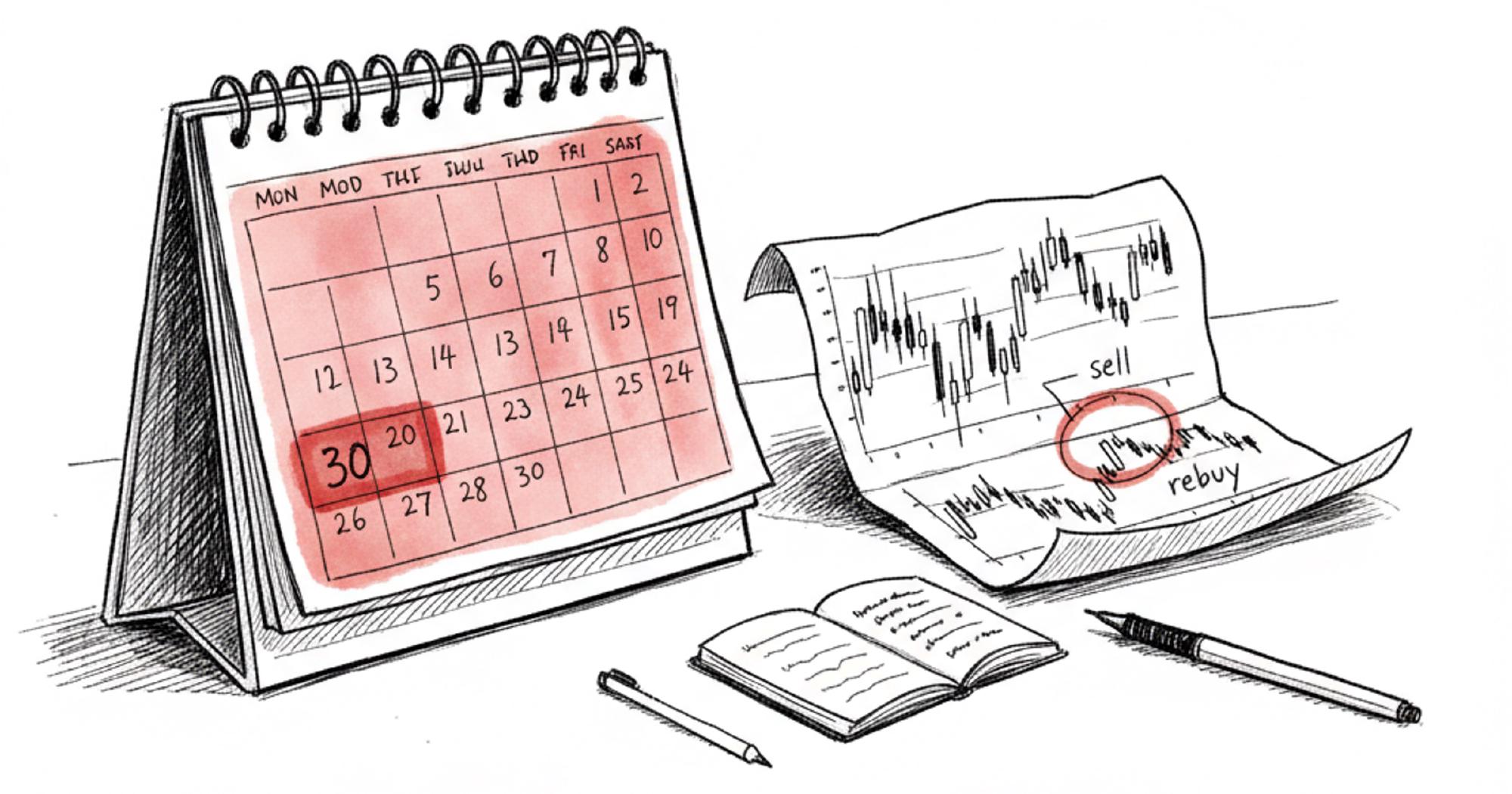
A wash sale happens when you sell a security at a loss and, within 30 days before or after the loss, you buy back a "substantially identical" security. The IRS disallows the loss for the current tax year. Instead, the disallowed loss is added to the cost basis of the replacement position, deferring the deduction until you eventually close the replacement.
For options traders, "substantially identical" is the trap. The IRS hasn't issued crystal-clear guidance on every scenario, but here's the working consensus:
- The same option contract is identical. If you sell a SPY June 500 call at a loss and buy it back within 30 days, that's a wash sale.
- An option on the same underlying with a different strike or expiration is generally NOT identical. A SPY June 500 call and a SPY July 510 call are typically treated as different positions for wash sale purposes.
- Selling a stock at a loss while holding an option on that stock can trigger a wash sale. If you sell AAPL shares at a loss and you currently hold AAPL calls, the IRS may treat the calls as the replacement security and disallow your loss.
- Section 1256 contracts are exempt from the wash sale rule. Yet another reason SPX is friendlier than SPY for active traders.
The 30-day window is what makes wash sales sneaky. It's not just 30 days after the loss—it's 30 days before and 30 days after. So if you bought AAPL on the 1st of the month and sold the same stock at a loss on the 15th, you've technically wash-saled yourself unless you stay out of AAPL for the next 30 days.
How to Avoid Wash Sales as an Options Trader
The defensive playbook is straightforward:
- Trade Section 1256 contracts when the strategy fits. SPX, NDX, /ES—none of them are subject to wash sale. If you're running zero-DTE or short-DTE index strategies, this is essentially a free pass.
- If you take a realized loss in December, stay out of that ticker (and its options) for at least 31 days. Mark the date on a calendar.
- Don't let your broker auto-roll a loss back into the same strike. Some platforms make it dangerously easy.
- If you trade the same ticker constantly, accept that wash sales will happen. They aren't necessarily a disaster—the disallowed loss just gets baked into a future cost basis. The IRS doesn't take the loss away forever, just delays it.
Record Keeping: The Habit That Saves You in April
Your broker will send you a 1099-B in February. Most active options traders assume the 1099 is correct and just hand it to the accountant. That's a mistake. Broker 1099s have known limitations:
- Wash sale calculations are often wrong when you trade across multiple accounts or move positions. Brokers only see what's in their own system.
- Cost basis adjustments from option assignment can be misreported, especially when the option was opened in a different tax year than the assignment.
- Section 1256 contracts may be reported on a separate Form 6781, which not all brokers handle cleanly.
- Iron condors and other multi-leg trades sometimes get reported as separate legs without the strategy context. You have to reconstruct the trade for proper bookkeeping.
The safest move is to maintain your own trade log. I keep a simple spreadsheet with these columns:
| Column | What I Track |
|---|---|
| Date Opened | The trade entry date. |
| Date Closed | The realization date for tax purposes. |
| Symbol & Contract | Underlying, strike, expiration, call/put. |
| Open / Close Premium | Per-contract pricing, both legs of any spread. |
| Net P/L | Total dollars after commissions. |
| Tax Treatment | Short-term, 60/40, or assignment-deferred. |
| Notes | Assignment, rolling, wash sale risk flag. |
Trade journal software like Edgewonk, Tradervue, or even a well-organized Google Sheet works fine. The format matters less than the discipline of doing it the same week as the trade. Reconstructing a year's worth of options trades the week before April 15 is a special kind of suffering I have done exactly once and will never do again.
Estimated Quarterly Taxes
If you make money trading options, the IRS expects you to pay tax on it as you earn it—not just at year-end. For most active traders this means quarterly estimated tax payments.
The general rule of thumb: if you'll owe more than $1,000 in tax for the year beyond what's withheld from any W-2 income, you should be making quarterly payments. Underpayment triggers a penalty plus interest at the IRS short-term rate, which has been north of 7% in recent years. That's a lot of drag for what is essentially a paperwork problem.
My personal rule: set aside 30% to 35% of every closed-trade profit into a separate savings account. The actual tax bill might end up at 25% or 28%, but having a buffer means I never have to scramble. The four quarterly due dates are roughly April 15, June 15, September 15, and January 15 of the following year.
Talk to a CPA about safe harbor rules—in some cases you can avoid penalties by paying 110% of last year's tax bill in equal quarterly installments, even if your trading income explodes this year. That can be a useful tool when you're having an unusually good year.
Trader Tax Status (TTS) and Mark-to-Market Election
This section is for traders doing serious volume. If options trading is a side activity producing a few thousand a year in income, skip it.
The IRS recognizes a designation called Trader Tax Status (TTS) for people whose trading activity is substantial, regular, continuous, and profit-seeking. Qualifying for TTS isn't a checkbox—it's a facts-and-circumstances test. The IRS looks at trade frequency, time spent on the activity, and whether trading is your primary income source.
TTS by itself doesn't change how trades are taxed, but it unlocks two things:
- Business expense deductions. Computers, subscriptions, education, home office—all deductible against trading income.
- The optional Section 475(f) mark-to-market election, which converts all trading gains and losses to ordinary income and exempts you from wash sale rules entirely. Losses become fully deductible against ordinary income (no $3,000 cap). The cost is that all open positions are marked to market at year-end and you give up the favorable 60/40 treatment on Section 1256 contracts.
TTS and 475(f) have specific election deadlines and IRS forms. Do not attempt this without a CPA who specializes in trader taxes. Robert Green's GreenTraderTax is the most-cited reference; whether you use them or not, the territory is specialized enough that a DIY mistake is expensive.
Tax-Advantaged Accounts: The Easiest Win
Everything above assumes a taxable brokerage account. There's a much simpler way to dodge most of these problems: trade options in a retirement account.
- Roth IRA: Contributions are after-tax, but every dollar of growth—including options profits—is tax-free at retirement. No 1099, no wash sale tracking, no quarterly estimates. Most brokers allow Level 2 to Level 3 options trading in IRAs (covered calls, cash-secured puts, basic spreads).
- Traditional IRA: Same shelter, but tax is owed on withdrawal at your future ordinary rate. Useful if you expect to be in a lower bracket later.
- Solo 401(k) or SEP-IRA: If you have self-employment income, these allow much higher annual contributions than a regular IRA.
My personal preference: I run a wheel strategy in my Roth IRA in addition to my taxable account. The taxable account profits are real but get clipped 25%+ by tax. The Roth profits compound completely tax-free. Same trades, dramatically different long-term outcome.
The downsides of trading in an IRA: no margin, no naked options, contribution limits, and you can't access the money before 59½ without penalty (though Roth contributions can be withdrawn any time). For a long-term income trader, those constraints are often worth the tax savings.
Common Tax Mistakes I See Active Traders Make
After years of talking to other traders, the same handful of mistakes show up over and over:
- Trading SPY when SPX would have given them 60/40 treatment. If you have $20,000+ to deploy on index strategies, SPX is almost always the right answer once you account for the tax delta.
- Failing to track wash sales across accounts. If you have a taxable account and an IRA both trading the same tickers, the IRS sees those as connected and wash sales can be triggered.
- Treating premium received on assignment as a separate gain. It's not—it adjusts cost basis. Double-counting it inflates your taxable income.
- Skipping quarterly estimated payments. The penalty is small per quarter but compounds quickly if you ignore it for a full year.
- Filing without a trader-savvy CPA. The H&R Block person who does your aunt's taxes does not know how Section 1256 contracts flow onto Form 6781. Pay for the right help.
- Selling losers in late December and re-buying in early January. Classic wash sale. The 30-day clock doesn't reset on January 1.
How Tax Awareness Changes My Trading
Here's the practical end of all this—how being tax-aware actually shapes the trades I take:
- I prefer SPX over SPY for any short-DTE index strategy. The 60/40 treatment is too valuable to ignore. The only time I'll touch SPY is when I'm running a small account that can't afford the SPX notional size.
- I run my wheel strategy in my Roth IRA whenever capital allows. All those short-term gains become fully tax-free.
- I track every trade weekly. Reconstructing 200+ trades in April is misery I'm not willing to repeat.
- I rarely sell losing positions in December for tax-loss harvesting purposes unless I'm confident I won't want back in for at least 31 days. The wash sale risk usually isn't worth a 30% deduction this year for a deferred loss next year.
- I auto-sweep 30% of every closed-trade profit from the brokerage to a high-yield savings account. By April, the tax bill is sitting there waiting.
None of this is glamorous. It doesn't make my P&L bigger. But it absolutely makes my after-tax P&L bigger, and that's the number that matters.
The Bottom Line
Options trading taxes are not optional, and they're not someone else's problem. For an active income trader, taxes are the single biggest cost line on the P&L—bigger than commissions, slippage, and platform fees combined. Every percentage point you save on tax efficiency is a percentage point added to your net return, every year, forever.
If you take only three things from this post, take these:
- Trade Section 1256 contracts when you can. The 60/40 rule is the biggest free lunch in retail trading.
- Use a Roth IRA for as much of your active trading as your contribution limits allow. Tax-free compounding eats the alternative.
- Find a CPA who actually understands trader taxes before you need one in April.
Once those three are in place, the rest of it—wash sales, quarterly estimates, record keeping—is just hygiene. Hygiene that pays you thousands of dollars a year. Worth doing.
Every trade I take is published live on Options Cafe, including the ones in my Roth and the SPX ones I run for tax efficiency. If you want to see what tax-aware active trading actually looks like in practice, the trade log is there.
Ready to learn options trading?
Start learning how to successfully trade options to earn monthly income.
Related Topics: Options Trading Taxes, How Are Options Taxed, Options Trading Tax Rules, Wash Sale Rule Options, Section 1256 Contracts, SPX Tax Treatment, Covered Call Taxes, Cash Secured Put Taxes, Credit Spread Taxes, 60/40 Tax Treatment