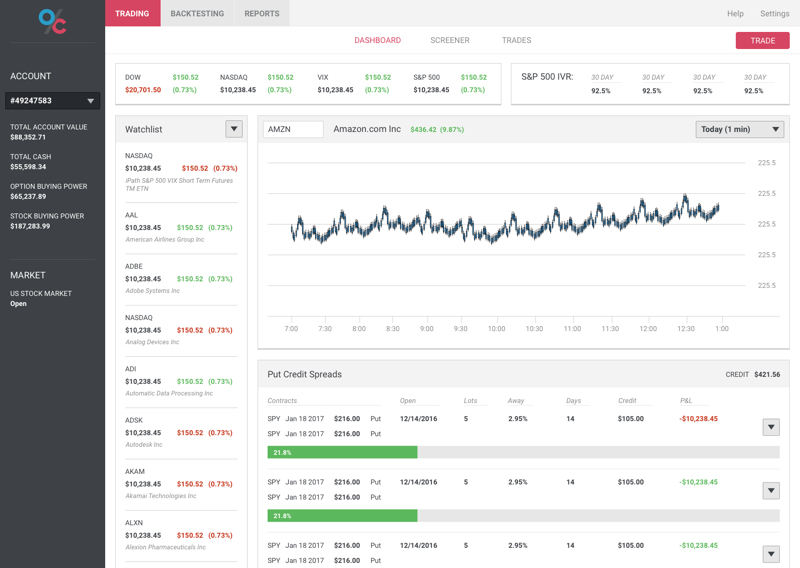
For the first few years I traded options, I was convinced the path to wealth was being right about where the market was headed. I read charts, drew trend lines, watched the news, and placed directional bets. Sometimes I won. More often, I gave it all back. The market doesn't care how confident you are. Options premium selling is the discipline that finally turned my trading around—and it's the entire philosophy behind Options Cafe.
If you've spent any time on Reddit's r/thetagang, you already know the creed: stop guessing direction, start collecting premium, and let time do the heavy lifting. This post is my playbook for exactly that. I'll walk you through what selling premium actually means, why theta decay is the edge, the full spectrum of premium-selling strategies ranked by difficulty, and the real results I've documented along the way—including the trades that lost money.
What Is Options Premium Selling?
Every option contract has a price, called the premium. When you sell an option, the buyer pays you that premium up front. In exchange, you take on an obligation—to buy shares if you sold a put, or to sell shares if you sold a call. As long as the option expires worthless or you buy it back cheaper than you sold it, you keep the difference. That difference is your income.
The reason this works so reliably comes down to a simple statistical truth: most options expire worthless. Option buyers are paying for the small chance of a big move. Most of the time, that big move never comes, and the premium they paid flows to the seller. Selling options premium puts you on the side of that probability instead of fighting against it.
This is the foundational idea that separates "theta gang" traders from everyone else. Directional traders try to win by being correct about price. Premium sellers win by being patient about time. Once that clicked for me, I stopped staring at charts trying to divine the next move and started building a process that collects income whether the market goes up a little, down a little, or sideways.
A Real Premium-Selling Trade, Start to Finish
Theory is easy to nod along to and hard to picture. So let me walk you through exactly what a single premium-selling trade looks like, with the kind of round numbers I work with every week. This is the cash-secured put—the first rung on the ladder and the cleanest way to see premium selling in action.
Say there's a stock I'd genuinely like to own, and it's trading at $25 a share. Instead of buying it, I sell one put option at the $22.50 strike with 35 days until expiration, and I collect a premium of $0.70 per share. Because each contract covers 100 shares, that's $70 in my account today. To be "cash-secured," I set aside $2,250—enough to buy 100 shares at $22.50 if I'm assigned. Now I wait. From here, only three things can happen:
- The stock stays above $22.50. The put expires worthless, the buyer walks away, and I keep the entire $70. On $2,250 of set-aside cash, that's a 3.1% return in 35 days—roughly 32% annualized if I keep repeating it. I'm free to sell another put and do it all again.
- The stock wobbles and I want out early. Thanks to theta decay, the put is usually cheaper than what I sold it for. I buy it back for, say, $0.20, lock in $50 of profit, and free up my capital ahead of expiration. I never have to hold to the bitter end.
- The stock drops below $22.50 and I'm assigned. I buy 100 shares at $22.50—but because I already pocketed $0.70 in premium, my real cost basis is $21.80. I now own a stock I wanted, at a discount to where it was when I started. From here I sell covered calls against those shares, and the wheel begins to turn.
Notice that in every single outcome, I either make money or end up owning a stock I chose at a price I liked. That asymmetry—where the "bad" outcome is still a planned, acceptable outcome—is the quiet magic of selling premium. There's no scenario where I'm staring at a screen praying for a reversal.
My Journey From Directional Trading to Premium Selling

I didn't start as a premium seller. Like most people, I came into options because I wanted leverage on my predictions. I'd buy calls when I thought a stock would rip and puts when I thought it would tank. The problem wasn't that I was always wrong—it's that I had to be right about two things at once: direction and timing. Even when I nailed the direction, theta decay quietly bled my long options to zero while I waited.
I wrote about this turning point in detail in why directional options trading is not for me, and again in the story of how I went from day trading to consistent monthly income. The short version: I got tired of the emotional whiplash. Some months I felt like a genius; others I felt like a fraud. There was no consistency, no process, and no peace of mind.
Selling premium fixed all three. Suddenly I had a repeatable system. I knew my maximum risk before I entered a trade. I knew roughly what I'd collect. And I no longer needed a crystal ball—I just needed discipline and a watchlist of solid stocks. The shift from buying hope to selling time is the single most important change I've made as a trader.
Why Theta Decay Is the Premium Seller's Edge
Theta is the Greek letter that measures how much value an option loses each day purely from the passage of time. It's why the community calls itself "theta gang"—theta is our paycheck. Every morning an option exists, it's worth a little less than it was the day before, and that decay accelerates as expiration approaches.
When you're long an option, theta is a tax you pay every day for holding. When you're short an option, theta is income that accrues to you every day you stay in the trade. Nothing has to happen for you to make money. The stock can sit there doing absolutely nothing and the option you sold quietly melts in your favor.
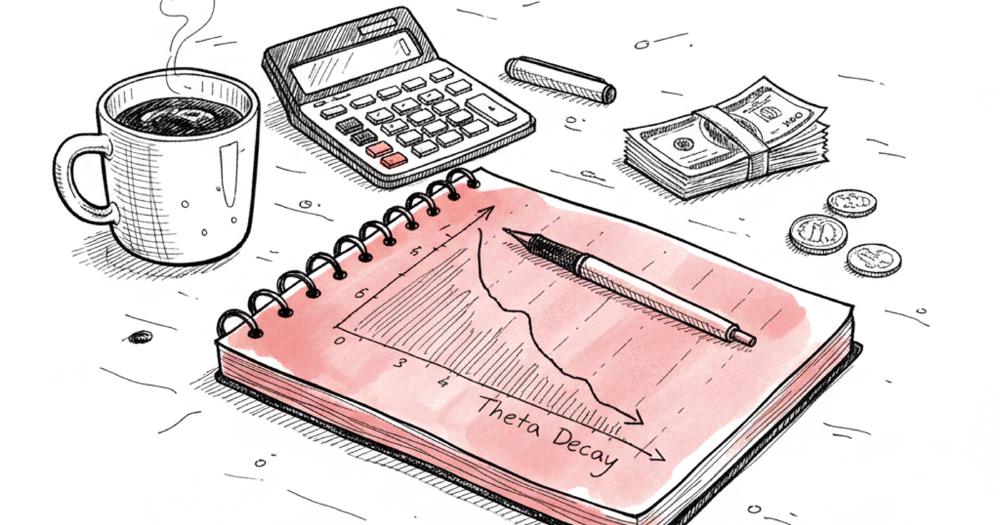
Here's what that looks like in practice. Theta decay isn't linear—it accelerates. An option with 45 days left might lose only a few cents a day. The same option with 10 days left can lose a much larger chunk daily, and in the final week it can fall apart entirely. That's the curve you saw on the notebook at the top of this post: gentle at first, then a cliff into expiration. As a seller, I want to be holding short options precisely through that steepening part of the curve, harvesting the fastest decay.
This is why I focus on selling options with 30 to 45 days until expiration—that's the sweet spot where theta decay is meaningful but you still collect a healthy premium. I'll often close a position once I've captured 50% to 80% of the premium, well before expiration, rather than squeezing out the last few dollars and exposing myself to a late surprise. If you want to go deeper on the mechanics, I broke down the full picture in how option Greeks affect the premium you trade. Understanding theta isn't optional for a premium seller. It's the entire reason the strategy works.
The Premium Seller's Strategy Spectrum

Premium selling isn't one strategy—it's a ladder. You start with the simplest, lowest-risk approaches and climb toward more advanced structures as your skill and capital grow. Here's how I think about the spectrum, from beginner to advanced, with the real returns I've earned on each where I have documented data.
| Strategy | Difficulty | What It Is | My Documented Results |
|---|---|---|---|
| Cash-Secured Puts | Beginner | Sell a put on a stock you'd happily own; collect premium while you wait. | Core of my $33K+ wheel income |
| Covered Calls | Beginner | Sell a call against shares you own; collect premium on stock you're holding. | Phase 2 of every wheel cycle |
| The Wheel | Intermediate | Combine CSPs and covered calls into a continuous income loop. | $33,000+ across 219 trades |
| Put Credit Spreads | Intermediate | Sell a put and buy a cheaper put below it to cap risk and reduce capital. | 265% returns since 2019 |
| Iron Condors | Advanced | Sell premium on both sides of a range-bound stock; profit if it stays put. | Defined-risk range trade |
| Zero DTE Iron Butterflies | Advanced | Sell tight premium that expires the same day on SPX; high reward, high variance. | 431% returns (and a rough 2025) |
Start Here: Cash-Secured Puts
If you're new to premium selling, this is your first rung. You set aside enough cash to buy 100 shares of a stock you actually want to own, then sell a put below the current price. If the stock stays up, you keep the premium. If it drops and you get assigned, you buy a stock you wanted anyway—at a discount. I covered the entire workflow in my guide to the cash-secured puts strategy. It's the cleanest introduction to getting paid for patience.
Add Covered Calls, Then Run the Wheel
Once you own shares—whether from assignment or just buying them—you sell a call against them to collect more premium. Read my full breakdown of the covered call strategy to see how I pick strikes. When you chain cash-secured puts and covered calls together on the same stock, you've got the wheel: sell puts until assigned, sell calls until called away, repeat. The complete system, with all my rules and results, lives in my wheel options strategy guide.
Level Up: Credit Spreads and Beyond
When you're comfortable and want to use less capital per trade, defined-risk spreads are the next step. My SPY put credit spreads have returned 265% since 2019 by selling premium far out of the money on an index that rarely drops fast. At the top of the ladder sit zero DTE iron butterflies on SPX—my most advanced strategy at 431% returns, though 2025 was a brutal reminder that higher reward comes with higher variance.
How to Know When You're Ready to Climb the Ladder
The biggest mistake I see new premium sellers make is skipping rungs. They read about 431% returns on iron butterflies and want to start there, ignoring the fact that those returns come with the kind of volatility that wipes out impatient traders. The ladder exists for a reason: each rung teaches you something you need for the next.
Cash-secured puts teach you to pick stocks you actually want and to stomach assignment. Covered calls teach you strike selection and the discipline of capping your upside for income. The wheel teaches you to run a continuous process across market cycles. Only once those feel automatic should you move to credit spreads, where you're managing defined risk and multiple legs—and only once that feels automatic should you touch same-day expiration trades. I spent years on the lower rungs before I ever sold a zero DTE butterfly, and I'm glad I did. The premium will still be there next month. Blown-up accounts don't come back as easily.
The Psychological Shift That Changes Everything
The hardest part of becoming a premium seller isn't the mechanics—it's the mindset. Directional trading is exciting. You place a bet, you watch it move, you feel something. Premium selling is deliberately boring. You sell an option, then you wait, sometimes for weeks, while almost nothing happens. For traders addicted to action, that boredom is agony at first.
But boredom is the point. The reason I stopped blowing up my account is that I stopped needing the market to entertain me. I wrote a whole post on how I prevent emotional trading, and the core lesson applies double to premium sellers: your edge is your process, not your predictions. When you remove the need to be right about direction, you remove most of the emotion that wrecks trading accounts.
There's also a humility built into selling premium. You're openly admitting you don't know where the market is going—and you're structuring your trades to profit anyway. That admission is freeing. I no longer feel pressure to have a market opinion. I just follow my rules, collect my premium, and let theta decay and probability do the work over hundreds of trades.
This is also where most premium sellers fail, and it has nothing to do with the strategy itself. They start strong, follow the rules, and collect income for months. Then one position goes against them, and instead of accepting an assignment or taking a small defined loss, they panic. They size up to "make it back," they hold losers too long hoping for a bounce, or they abandon the process entirely after one bad week. The mechanics of premium selling are simple enough to learn in an afternoon. The discipline to keep running the process when it's boring—and to not abandon it when one trade stings—is what actually separates profitable premium sellers from the rest. I wrote more about that distinction in mechanical versus emotional trading, because it's the difference between a hobby that costs money and a system that makes it.
Risk Management for Premium Sellers
Selling premium has a sneaky danger: you win small amounts often, which makes it easy to forget that a single oversized loss can erase months of gains. The cliché is that premium sellers "pick up nickels in front of a steamroller." That's only true if you're reckless about size. Done right, you're picking up nickels with the steamroller safely parked. Here are the rules I never break:
- Position sizing first. I never put more than about 5% of my account at risk on a single underlying. With dozens of small positions, no one trade can take me down.
- Only sell on stocks you'd own. If a cash-secured put gets assigned, I want to be happy holding the stock. That single rule turns most "losses" into discounted entries.
- Define your risk when you can. Spreads, condors, and butterflies cap your maximum loss the moment you enter. Naked premium selling does not—respect that difference.
- Have an exit before you enter. I know my profit target and my line in the sand before I place the trade, so I'm never improvising under pressure.
- Diversify across stocks and strategies. Running the wheel, credit spreads, and the occasional butterfly across many tickers means no single event sinks the whole ship.
Who Premium Selling Is NOT For
I want to be honest, because too much of the internet pretends every strategy is for everyone. Premium selling is a phenomenal way to build steady income, but it's the wrong fit for some people:
- If you want to get rich quick, look elsewhere. Selling premium grinds out small, repeatable gains. It is the opposite of a lottery ticket.
- If you can't tolerate assignment, you'll panic the first time you're put 100 shares. Premium sellers have to be genuinely comfortable owning the stocks behind their puts.
- If you crave excitement, you'll get bored and start breaking your own rules. The strategy rewards the patient and punishes the restless.
- If you have very little capital and no patience to grow it, the early returns will feel tiny. That said, you can absolutely start small—I show how in my guide to running the wheel strategy with a small account.
None of those are knocks on you. They're just signs that your temperament might be better suited to a different approach. But if steady, unglamorous, process-driven income sounds appealing—welcome to theta gang.
Where Options Cafe Fits in the Theta Gang Community
Reddit's r/thetagang is 350,000-plus traders who all believe the same core idea: sell premium, collect income, stop guessing. It's a fantastic community, but it's also scattered—thousands of one-off threads with no structure, no track record you can follow over time, and no system tying it all together.
That's the gap Options Cafe fills. I'm one trader, selling premium with real money, logging every single trade in public. Right now I have open put-phase positions on CHWY and RIVN, and you can watch them play out in real time alongside the hundreds of trades already in my history. There's no cherry-picking—my winners like TSLA, HIMS, and HOOD (each over $3,900) sit right next to my INTC loss for anyone to see.
If the theta gang philosophy resonates with you, I'd love to have you follow along. Browse my documented monthly income, read through the strategy guides linked throughout this post, and see whether selling premium is the approach that finally brings consistency to your trading the way it did to mine.
Frequently Asked Questions About Selling Options Premium
Is selling options premium actually profitable?
Yes—when it's done with discipline and proper position sizing. My documented wheel trades, built entirely on selling premium, have produced over $33,000 across 219 trades. The key word is documented: these are real, public trades, not a backtest. Profitability comes from collecting small premiums repeatedly across many positions, not from hitting home runs. Individual trades still lose; the edge shows up over hundreds of them.
What does "theta gang" mean?
"Theta gang" is the nickname for traders whose strategy revolves around selling options to collect theta—the daily time decay of an option's value. The term comes from Reddit's r/thetagang community of 350,000-plus traders. Instead of betting on direction, theta gang traders profit from the passage of time and the statistical reality that most options expire worthless.
How much money do I need to start selling premium?
You can start a cash-secured put on a low-priced stock with as little as $1,500 to $2,500, since you need enough cash to cover assignment of 100 shares. Defined-risk strategies like put credit spreads require even less per trade because your maximum loss is capped. I'd recommend at least $5,000 to diversify properly—I cover exactly how in my wheel strategy with a small account guide.
Is selling premium safer than buying options?
In terms of probability, yes—the seller wins far more often because time and decay are on their side. But "wins more often" is not the same as "lower risk." Naked premium selling can carry large, sometimes undefined, losses on the rare bad trade. That's why position sizing and defined-risk structures matter so much. The strategy is high-probability, not no-risk.
What's the best premium-selling strategy for beginners?
Start with cash-secured puts on a stock you'd be happy to own, then add covered calls once you hold shares. Together those two form the wheel—the perfect on-ramp because the worst case is simply owning a good stock at a discount. Master that before climbing to credit spreads, iron condors, or zero DTE butterflies.
I stopped trying to predict the market years ago, and it was the best decision I ever made as a trader. The market is unpredictable in the short run, but time and probability are not. Premium selling lets you trade the things that are reliable instead of the things that aren't. That's not a trick or a secret—it's just a better side of the options market to stand on.
Ready to learn options trading?
Start learning how to successfully trade options to earn monthly income.
Related Topics: Options Premium Selling, Theta Gang, Theta Gang Strategies, Selling Options Premium, Premium Selling Strategy, Selling Options for Income, Theta Decay, Options Income Strategy, Cash Secured Puts, The Wheel Strategy