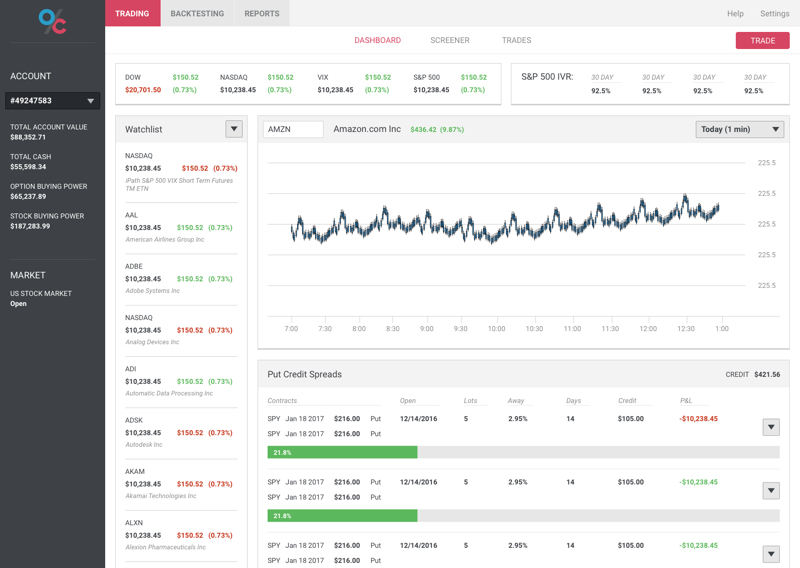
I have generated $34,615 in documented wheel strategy profit across 229 trades. Every one of those dollars is a short-term capital gain, which means it gets taxed at my ordinary income rate. Depending on your bracket, that is 22% to 37% federal before your state takes a bite.
Now run the same trades inside a Roth IRA and the tax bill is zero. Not lower. Zero. Same strikes, same premiums, same assignments, same screen time—and none of it shows up on a 1099. That is the single biggest, least-discussed edge available to anyone selling options for income, and I document every trade I make in the open so you can see exactly what it applies to.

Why an IRA Is Actually the Best Account for the Wheel Strategy
Most people think of an IRA as a place to park index funds and forget about them. That's a shame, because the tax characteristics of a retirement account line up almost perfectly with how the wheel strategy actually behaves.
Here's the mismatch that hurts wheel traders in a taxable account:
- Every premium is a short-term gain. You sell a put with 30 to 45 days to expiration. It expires worthless or you buy it back. That holding period is never long enough for long-term treatment. Ordinary income rates, every single time.
- You trade constantly. I closed 77 trades in 2026 so far. Each one is a taxable event that has to be tracked, reconciled, and reported.
- Assignment resets your cost basis in ways that complicate everything. Get assigned, sell a covered call, get called away—now you have a stock sale with an adjusted basis on top of the option premium.
- Wash sales are a constant threat. The wheel deliberately re-enters the same tickers over and over. That is the exact pattern the wash sale rule was written to catch.
Inside an IRA, all four of those problems vanish. There is no 1099-B to reconcile. There is no wash sale tracking, because wash sales only matter when you're claiming losses against taxable income. There are no quarterly estimated payments. You place trades, you collect premium, and the account balance goes up.
I go deep on the taxable-account version of this in my options trading tax guide. This post is about the version where most of that complexity simply doesn't apply.
Roth IRA: The Completely Tax-Free Version

A Roth IRA is funded with money you have already paid taxes on. In exchange, qualified withdrawals in retirement are completely tax-free—contributions and growth alike.
For a wheel trader, that phrase "and growth alike" is doing enormous work. Options premium is growth. If you contribute $7,500 this year and turn it into $9,000 selling cash secured puts, that $1,500 is never taxed. Not when you earn it, not when you reinvest it, not when you withdraw it at 60.
Compare that to the taxable version. In a 24% federal bracket with a 5% state tax, that same $1,500 of premium is worth about $1,065 after tax. You just lost 29% of your edge to a line item you never see on your broker statement.
The 2026 contribution limit is $7,500, or $8,600 if you're 50 or older with the $1,100 catch-up. That is a combined limit across all your IRAs, not per account. Roth contributions also phase out at higher incomes, which is worth checking before you fund one.
Traditional IRA: Tax-Deferred, Still Powerful
A traditional IRA doesn't eliminate tax—it defers it. Contributions may be deductible now, growth compounds untaxed, and you pay ordinary income rates on withdrawals in retirement.
For active options trading, deferral is still a large win. Every dollar you would have sent to the IRS in April stays in the account and keeps selling puts. Over a decade of compounding, that difference is not small.
The trade-off is that wheel premium eventually gets taxed at ordinary rates on withdrawal—which is the same rate it would have faced in a taxable account, just decades later. A Roth converts that "later" into "never." If you have the choice and you qualify, the Roth is the better home for an income strategy.
Roth vs. Traditional vs. Taxable: The Practical Comparison
| Factor | Roth IRA | Traditional IRA | Taxable Account |
|---|---|---|---|
| Tax on premium | None, ever | Deferred to withdrawal | 22–37% the year you earn it |
| Wash sale tracking | Not applicable | Not applicable | Constant headache |
| Margin available | No | No | Yes |
| Naked options | No | No | With approval |
| Annual contributions | $7,500 ($8,600 if 50+) | $7,500 ($8,600 if 50+) | Unlimited |
| Access to funds | Contributions anytime; growth at 59½ | 59½ or penalty | Anytime |
| Can deduct losses | No | No | Yes |
That last row is the honest counterweight. In a taxable account, a losing trade at least gives you a deduction. In an IRA, a loss is just a loss. My INTC wheel positions are down $555 across 3 trades—in a taxable account that offsets other gains, and in an IRA it doesn't. If your strategy loses money over time, the IRA makes it worse, not better.
Can You Actually Trade Options in an IRA?

Yes. This is the question the broker FAQ pages answer and then stop, so let me go a step further and explain what you're actually applying for.
Brokers gate options behind approval levels. The naming differs by firm, but the ladder is roughly the same:
- Level 1: Covered calls and cash secured puts. This is the entire wheel strategy. Most brokers grant it in an IRA without much friction.
- Level 2: Long calls and puts, plus the above.
- Level 3: Debit and credit spreads. Available in IRAs at many brokers, though some require a higher balance.
- Level 4: Naked calls and puts. Never available in an IRA. Retirement accounts can't take on unlimited or borrowed risk.
For the wheel, Level 1 is genuinely all you need. Selling a cash secured put and selling a covered call are the only two trades in the strategy. If you also want to run put credit spreads, you'll need Level 3, and you'll want to confirm your broker supports spreads in retirement accounts specifically—a few still don't.
The application asks about your income, net worth, trading experience, and objectives. Answer it honestly. If you get denied, most brokers let you reapply after you've built a track record, and some will upgrade you over the phone.
The One Real Limitation: No Margin
IRAs cannot borrow. That's not a broker policy, it's federal law—using retirement assets as collateral for a loan is a prohibited transaction. What you can get is "limited margin," which only speeds up settlement so you don't trip good-faith violations. It does not give you buying power.
Practically, this means every put you sell must be fully cash secured. Want to sell a $30 strike put? You need $3,000 in cash sitting in the account, untouched, until the position closes.
I've written about using margin to amplify wheel returns in a taxable account, and it does work. But I'd argue the IRA constraint is a feature. Margin is how wheel traders blow up. A leveraged put seller in a sharp drawdown faces assignment on positions they can't actually afford, gets a margin call at the worst possible moment, and is forced to liquidate into weakness. The no-margin rule makes that failure mode structurally impossible.
The other constraints worth knowing: you can't deposit more than the annual limit to rescue a bad position, and you generally can't touch the money before 59½ without a 10% penalty. Roth contributions—not growth—can be withdrawn anytime, which softens this considerably.
Rolling Positions When You Can't Use Margin
Rolling—buying back a put that's gone against you and selling a new one further out in time—is the core defensive move in the wheel. It works fine in an IRA, but the cash mechanics are stricter and worth understanding before you need them.
In a margin account, you can roll down to a lower strike freely because the broker fronts the difference. In an IRA, rolling down means the new strike requires less collateral, which is fine. Rolling out in time at the same strike is also fine. What you cannot do is roll into a position that requires more collateral than you have sitting in cash.
The practical rule I follow: never deploy so much capital that a defensive roll becomes impossible. If a stock drops 20% and I want to roll down and out to buy time, I need the room to do it. That's the real reason I hold 15–20% cash rather than any theory about market timing.
There's also a settlement wrinkle. Without limited margin enabled, proceeds from a closing trade may not settle for a day, and trading with unsettled funds triggers a good-faith violation. Most brokers offer limited margin on IRAs specifically to solve this. Turn it on—it doesn't give you leverage, it just lets you use your own money the same day.
What About 401(k)s and Solo 401(k)s?
Employer 401(k) plans almost never allow options trading. The plan administrator picks a menu of funds and that's what you get. A few plans offer a self-directed brokerage window that may permit covered calls, but it's uncommon and usually limited.
If you have an old 401(k) from a previous employer, rolling it into an IRA is the move that unlocks this entire strategy. That rollover is not a taxable event when done correctly, and it converts a restricted fund menu into an account where you can actually sell puts.
If you have self-employment income, a Solo 401(k) is worth a serious look. The contribution limits are dramatically higher than an IRA—you can contribute both as employee and employer—and many providers allow options trading. For someone running a business on the side, this is the fastest way to build a large tax-sheltered pool of capital to wheel with.
What Tax-Free Compounding Actually Looks Like
Here's my actual documented wheel performance, all of it visible on the results page:
| Year | Trades Closed | Profit | Tax at 29% (Taxable) |
|---|---|---|---|
| 2024 | 28 | $4,652 | $1,349 |
| 2025 | 124 | $19,791 | $5,739 |
| 2026 (YTD) | 77 | $10,172 | $2,950 |
| Total | 229 | $34,615 | $10,038 |
That right-hand column is the whole argument. Roughly $10,000 of tax on the same set of trades, using a blended 29% rate that's realistic for a lot of working professionals. Inside a Roth IRA, that column is $0 all the way down.
And it's worse than a one-time $10,000, because that money would have kept working. Ten thousand dollars of retained premium selling puts at even a modest 12% annual return compounds into meaningfully more over a decade. The tax isn't just a cost—it's a cost plus everything that money would have earned.
Realistic Income at Different IRA Balances
I'm going to be conservative here, because the retirement account is not the place for optimistic math. Assume a well-run wheel generates 1% to 2% per month on deployed capital in normal conditions, and that you keep some cash in reserve.
| IRA Balance | Positions You Can Run | Conservative Monthly Premium |
|---|---|---|
| $25,000 | 3–5 | $200–$400 |
| $50,000 | 5–8 | $400–$800 |
| $100,000 | 8–12 | $800–$1,600 |
| $250,000 | 15–20 | $2,000–$4,000 |
These are premium collected, not net profit. Assignments and drawdowns will pull the real number down in bad months, and there will be bad months. The point of the table is scale, not a promise. And in a Roth, whatever that number ends up being, you keep all of it.
Common IRA Options Mistakes
Treating It Like a Casino Because "It's Not Taxed"
The tax shelter tempts people into more aggressive positions than they'd take in a taxable account. That's backwards. This is retirement money with a hard annual contribution cap—you cannot easily replace what you lose. Size positions more conservatively here, not less.
Not Leaving Enough Cash for Assignment
Without margin, a cash crunch shows up fast. If you have $30,000 and sell three puts that each require $10,000 of collateral, you are fully deployed with nothing left. When one gets assigned and you want to roll or add, you have no room. I keep 15–20% in cash at all times.
Running the Same Wheel in Both an IRA and a Taxable Account
This one is genuinely dangerous and almost nobody mentions it. If you sell a losing position in a taxable account and buy a substantially identical one in your IRA within 30 days, it triggers a wash sale—and the disallowed loss is permanently lost. It doesn't get added to your IRA basis the way a normal wash sale defers into the replacement position. It just disappears. Trade different tickers in each account.
Picking Junk Stocks for the Premium
High implied volatility means fat premiums and it also means the stock can fall hard and stay there. In a taxable account you can at least harvest the loss. In an IRA you're just holding a bad stock. Stick to companies you'd genuinely be fine owning for a couple of years—my stock selection process covers how I filter.
Which Brokers Allow Options in IRAs
Most major brokers support covered calls and cash secured puts in retirement accounts. Where they differ is spreads, approval friction, and how limited margin is handled:
- Schwab / thinkorswim: Strong IRA options support including spreads. Excellent platform for managing multiple wheel positions.
- Fidelity: Covered calls and cash secured puts are straightforward. Spread approval in IRAs is more restrictive.
- Tastytrade: Built for options traders. Good IRA support and a smooth approval process.
- Interactive Brokers: Full-featured, lowest commissions, steeper learning curve.
- E*TRADE: Solid IRA options support with a clean interface.
Before you commit, call and ask two specific questions: what options level do you approve for IRAs, and do you allow spreads in a retirement account? The answers vary more than the marketing pages suggest. My broker comparison tool can help you compare commissions, which matter when you're placing a hundred-plus trades a year.
How I Actually Run This
I run the wheel in a Roth IRA alongside my taxable account. The strategy is identical—same put selling methodology, same covered call approach, same 30 to 45 day expirations. What changes is the tickers and the sizing.
In the IRA I lean toward stocks I'm comfortable holding through a rough stretch, because I can't harvest a loss there. Position sizes are smaller relative to the account, and I keep a larger cash buffer since there's no margin to lean on. Right now I have open positions on CHWY in the put phase and DKNG in the call phase, and I deliberately don't run the same names on both sides of the wash sale line.
If you're starting with a smaller balance, most of what I wrote in the $5,000 wheel strategy guide applies directly—the stock picks and position sizing work the same way in a retirement account.
Getting Started This Week
- Check your options approval. Log into your IRA and look for options trading in account settings. If you're not approved, apply for Level 1.
- Decide how much to deploy. Don't convert the whole account at once. Start with a slice you're comfortable putting to work while you learn.
- Pick one stock. One position, one ticker, something you understand. Run a full wheel cycle before adding a second.
- Find a strike. The free wheel options screener filters by stock price, premium, and probability of profit—it's the same tool I use.
- Track everything. You won't get a useful 1099, so keep your own log of premium collected and assignments.
One honest caveat: I'm a trader, not a CPA. The tax mechanics here are well-established, but your income, filing status, and existing retirement accounts all affect what makes sense for you. Talk to a tax professional before restructuring anything.
The Bottom Line
The wheel strategy produces exactly the kind of income that taxable accounts punish hardest—frequent, short-term, ordinary-rate gains. A Roth IRA erases that penalty entirely.
If you have a six-figure retirement account earning 4% in a money market fund, you're leaving real money on the table. The strategy isn't complicated. It's two trades repeated with discipline. And in a retirement account, you keep every dollar of what it produces.
You can follow along with every position I open and close on the results page—229 trades, wins and losses, nothing hidden. When you want the full system with real-time trade alerts, the course is here.
Ready to learn options trading?
Start learning how to successfully trade options to earn monthly income.
Related Topics: Options Trading in IRA, Wheel Strategy IRA, Selling Puts in Retirement Account, Roth IRA Options Trading, Tax Free Options Income, Covered Calls in IRA, Cash Secured Puts IRA, Retirement Account Options, Wheel Strategy, Options Income Strategy