How Put Selling Actually Uses Your Cash
Before we get into margin strategies, you need to understand something about the put-selling phase of the wheel that most people overlook: you do not spend any money when you sell a put. In fact, you receive money. The premium is deposited directly into your account the moment the trade executes.
So where does the cash requirement come in? Your broker freezes a portion of your account as collateral. This frozen amount is called the option requirement (also referred to as the buying power reduction or margin requirement, depending on your broker). It ensures you have the funds available if you get assigned the stock.
Here is the critical distinction: the option requirement is a freeze, not a charge. That cash is still yours. It is sitting in your account. You just cannot withdraw it or use it for other trades while the put is active. If the put expires worthless, the freeze lifts immediately and you walk away with more cash than you started with.
Do Brokers Pay Interest on Frozen Cash?
This is where things get interesting—and where many wheel traders are unknowingly leaving money on the table. Some brokers pay interest on your entire cash balance, including the cash frozen for option requirements. Others pay nothing.
For example, Interactive Brokers pays interest on idle cash balances (approximately 3-4% depending on current rates for accounts with $100,000 or more). Fidelity automatically sweeps your cash into a money market fund (SPAXX) that earns a competitive rate, and that includes cash reserved for option collateral. On the other hand, some brokers pay little to nothing on cash held as option requirement collateral.
This matters because if your frozen cash earns interest, you are already getting a return on top of your premium income without doing anything extra. Check your broker's policy on interest for cash held as option collateral. It can make a meaningful difference in your annual returns.
What Is BOXX and Why It Matters for Wheel Traders
If your broker does not pay interest on cash held for option requirements—or pays a low rate—there is another option: the BOXX ETF (Alpha Architect 1-3 Month Box Rate ETF).
BOXX is an ETF that uses an options strategy called a box spread to replicate the returns of 1-3 month U.S. Treasury bills. A box spread combines four options legs on the S&P 500 Index (SPX) in a way that produces a guaranteed, fixed payout at expiration regardless of where the market trades. The difference between what the fund pays to enter the box spread and the fixed payout at expiration is effectively the risk-free interest rate.
The result is an ETF that behaves like a money market fund—steady, predictable, upward-moving NAV—but with a major tax advantage. Traditional money market funds and T-bills distribute interest income that is taxed as ordinary income every year (up to 37% federal). BOXX pays no distributions. Its value simply appreciates over time. You owe nothing until you sell, and when you do, the gain qualifies as a capital gain. Hold it for over a year and you pay the long-term capital gains rate (maxing out at 20% federal), which is nearly half the top ordinary income rate.
BOXX currently yields approximately 4% annually and has attracted over $9 billion in assets since its launch in late 2022.
How Wheel Traders Use BOXX
Here is the strategy: instead of keeping your account balance in cash, you invest it in BOXX. Your BOXX holdings earn approximately 4% annually while your money sits there. When you sell puts, your broker uses your available margin to cover the option requirement—not your BOXX position. The broker does not charge you margin interest for this because the option requirement is collateral, not a loan. You only get charged margin interest if you actually get assigned stock and do not have enough cash to pay for the shares.
If you do get assigned, you simply sell enough BOXX to pay off the margin balance and eliminate the interest charges. The key insight is that for the vast majority of the time when your puts expire worthless, your entire account balance is earning interest through BOXX while simultaneously serving as backing for your put-selling activity.
One important caveat: not all brokers treat BOXX identically for margin purposes. Before building your strategy around BOXX, confirm with your specific broker that BOXX holdings are marginable and that margin is available for option requirements against your BOXX position.
What Is a Reg-T Margin Account?
Before we get into the math, let me quickly explain what a Reg-T margin account is, since it is central to both strategies.
Regulation T is a Federal Reserve Board regulation that governs how much credit (margin) brokerage firms can extend to investors. Under Reg-T:
- Initial margin requirement: You must put up at least 50% of a stock purchase with your own equity. So with $100,000 in your account, you could buy up to $200,000 worth of stock.
- Maintenance margin: You must maintain at least 25% equity (FINRA minimum), though most brokers set their house requirement higher at 30%.
- Margin interest: You only pay interest when you actually borrow money (i.e., when you have a negative cash balance). Simply having a margin account does not cost anything.
For put sellers, the important detail is that naked put margin requirements are much lower than the full cash-secured amount. A cash-secured put on a $50 stock requires $5,000 per contract. A naked put on margin might require only $1,000-$1,500 per contract (roughly 20-25% of the underlying price). This is what creates the opportunity to amplify returns.
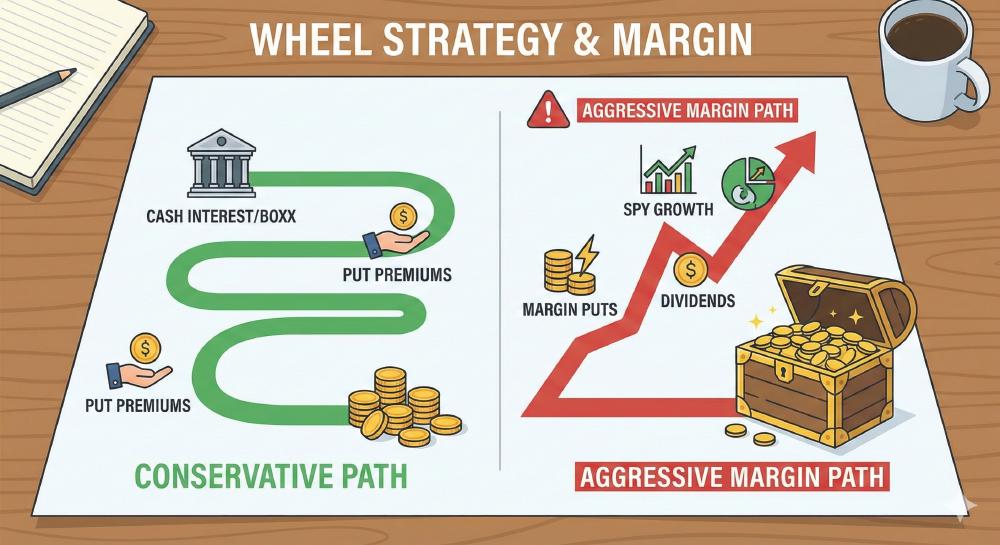
The Conservative Approach: Cash + Interest + Put Premiums
This first strategy adds zero additional risk to your wheel trading. It simply ensures your idle cash is not sitting around earning nothing while it serves as collateral.
The idea is straightforward: keep your entire account in cash (at a broker that pays interest on option requirement collateral) or invest it in BOXX. Then sell puts as you normally would. You collect two income streams—put premiums and interest—on the same pool of capital.
The Math
Let's walk through the numbers with a $100,000 account:
| Income Source | Calculation | Annual Return |
|---|---|---|
| Put premiums | 2% per 30-day cycle × 12 cycles | $24,000 (24%) |
| Interest / BOXX yield | $100,000 × 4% | $4,000 (4%) |
| Total | $28,000 (~28%) |
The 2% monthly premium target is based on selling puts at a strike price roughly 5-10% out of the money on quality stocks. This aligns with my comprehensive wheel strategy guide where I break down how I select strike prices and expirations.
This approach is a no-brainer for every wheel trader. You are not adding any risk. You are not using leverage. You are simply making your capital work double duty: serving as put collateral while earning interest. The extra 4% (at today's rates) is essentially free money for doing what you were already doing.
The Aggressive Approach: SPY + Margin for Put Selling
Now we get into the strategy that can produce eye-popping returns—and the one that requires a very specific financial profile to execute responsibly. This is only for seasoned traders with reliable outside income. This is my personal strategy.
The Core Idea
Instead of keeping your $100,000 in cash or BOXX, you invest it in SPY (the S&P 500 ETF). Now your capital is participating in the overall market growth plus dividends. On top of that, your $100,000 in SPY gives you margin buying power in a Reg-T account. As a general rule, your broker may extend roughly $200,000 in margin buying power above your holdings (the exact amount varies by broker and account type).
You then use that margin buying power to sell puts—just like you would in the regular wheel strategy, but now backed by margin instead of cash.
This creates three simultaneous income streams from a single $100,000 account:
- SPY capital appreciation — participation in the broad market's long-term uptrend
- SPY dividends — currently around 1.2% annually
- Put premium income — collected on up to $200,000 worth of margin-backed positions
The Math
| Income Source | Calculation | Annual Return |
|---|---|---|
| SPY returns | $100,000 × 13% (includes dividends) | $13,000 (13%) |
| Put premiums | $200,000 × 2% × 12 cycles | $48,000 (48%*) |
| Total | $61,000 (~61% on original $100K) |
*48% is calculated on $200K in margin-backed positions, representing 48% of the original $100K account value.
The 13% SPY return is based on historical averages. The S&P 500 has returned roughly 10-13% annualized over various long-term periods including dividends. Some years it is much higher, some years it is negative. I use 13% as an optimistic but historically supported illustrative figure.
Why This Is Significantly More Risky
The math above looks incredible. But it assumes a good year. Here is what happens when the market does not cooperate:
- SPY declines: In a bad year, SPY could drop 20-30%. Your $100,000 becomes $70,000-$80,000.
- Margin buying power shrinks: As SPY drops, your account equity drops with it. Your broker reduces your available margin.
- Puts go in the money: If the market is falling, your short puts are likely losing money at the same time your collateral is shrinking.
- Margin call: Your broker demands you deposit more cash or close positions. This happens at the worst possible time—when everything is already down.
Margin Calls: The Risk You Must Understand
If you are going to trade the aggressive approach, you need to thoroughly understand margin calls. This is the section that separates traders who survive drawdowns from traders who blow up their accounts.
What Triggers a Margin Call
Your broker monitors your account equity versus your margin requirements in real time. If your equity drops below the maintenance margin requirement (typically 25-30% of your total position value), you receive a margin call. For put sellers using the aggressive approach, this typically happens when:
- The market drops sharply and multiple puts move deep in the money simultaneously
- Your SPY holdings decline, reducing your total account equity and available margin
- Your broker increases margin requirements during volatile markets (they can do this without advance notice)
What Happens During a Margin Call
When you receive a margin call, you generally have a very short window to respond—sometimes 24-48 hours, sometimes less. You must either deposit additional cash or close positions to bring your account back within margin requirements. If you do not act fast enough, your broker will liquidate your positions at market prices without your consent. They are not required to contact you first, and they do not care about your cost basis, your strategy, or what you think the market is going to do. Forced liquidation always happens at the worst time because margin calls are triggered during market declines.
Why Outside Income Is Your Safety Net
This is precisely why the aggressive approach requires reliable outside income. When a margin call hits, you need the ability to wire cash to your brokerage quickly. If your only money is in the trading account, you have no safety net. A margin call becomes a forced liquidation.
This is my personal approach: I manage how much margin I take on based on my personal expenses and monthly income. I have emergency savings and regular income outside of trading. In the case of a margin call, I can cover it. In a big drawdown, I might have to sacrifice a family trip, miss an alternative investment opportunity, or delay a big purchase—but I can handle a drawdown with additional cash.
What I never do is manage risk based on my prediction of where the market is going. I do not have a crystal ball. Nobody does. Instead, I size my margin usage so that even in a significant downturn, the amount I would need to cover a margin call is within my ability to produce from outside income and savings.
If you want to see what market drawdowns actually feel like in practice, read my post on what I learned from the brutal 2025 drawdowns. It is a raw, honest look at watching gains evaporate—and that was without heavy margin usage.
Which Approach Is Right for You?
Choose the Conservative Approach If...
- You are primarily focused on income, not growth
- You do not want equity market exposure beyond your put obligations
- You are risk-averse and want better returns than bonds without adding leverage
- You are trading in a retirement account (where margin is typically not available)
- You are newer to the wheel strategy and want to improve returns without adding complexity
Choose the Aggressive Approach If...
- You have significant, reliable outside income that can cover margin calls
- You already want broad market exposure (SPY) and are looking for ways to generate additional income on top of it
- You understand and accept the risk of simultaneous losses on SPY and your put positions
- You have experience managing margin accounts and understand buying power mechanics
- You have been trading the wheel for at least 6-12 months and are comfortable with the mechanics
A Middle Ground
You do not have to pick one approach exclusively. Many experienced traders blend both. For example, you could invest $50,000 in SPY and keep $50,000 in cash or BOXX, then use partial margin for put selling. This gives you some market exposure, some interest income, and amplified put premiums—but with less leverage risk than going all-in on the aggressive approach.
Practical Tips for Trading the Wheel on Margin
- Start with the conservative approach first. Add margin only after you have at least 6 months of cash-secured wheel experience under your belt.
- Never use more than 50-60% of available margin. Keep a buffer for market volatility. Margin calls happen when you least expect them.
- Diversify your put positions across sectors. Do not sell all your puts on correlated stocks. A sector-wide decline will hit all your positions at once. The Options Cafe screener can help you find opportunities across different sectors.
- Monitor your buying power daily. Set alerts if your broker offers them. Know your maintenance margin requirement and how much of a decline it would take to trigger a margin call.
- Keep emergency cash outside your brokerage account. Have funds you can wire to your broker within 24 hours if needed.
- Reduce position sizes during high-volatility periods. When the VIX spikes or major macro uncertainty hits, scale back your margin usage. Brokers often increase margin requirements during volatile markets.
- Know your broker's margin call timeline. Some give you 24-48 hours to meet the call. Others can liquidate positions immediately. Know the rules before you need them.
- If using BOXX, confirm with your broker. Verify that BOXX is marginable at your specific brokerage and that it counts toward your option requirement before building your strategy around it.
Frequently Asked Questions
What is margin in the context of selling puts?
Margin is borrowed buying power from your broker, collateralized by assets in your account (cash, stocks, ETFs). When selling puts on margin, you do not need the full cash to cover potential assignment. Instead, your broker requires a fraction of the full obligation as collateral (the option requirement). You only pay margin interest if you are assigned stock and do not have enough cash to cover the purchase.
Can I sell puts on margin in an IRA?
Generally, no. Most IRA accounts restrict margin trading. All puts sold in an IRA must be fully cash-secured. The conservative approach (earning interest or holding BOXX while selling cash-secured puts) works in an IRA, but the aggressive approach using margin does not.
What is the BOXX ETF?
BOXX (Alpha Architect 1-3 Month Box Rate ETF) is an ETF that uses options box spreads to replicate Treasury bill returns. It yields approximately 4% annually, pays no distributions (so you defer taxes until you sell), and when sold after holding for more than a year, gains are taxed at the lower long-term capital gains rate instead of the ordinary income rate. Wheel traders use it as a cash alternative that earns a return while their money serves as backing for put-selling activity.
How much margin should I use for put selling?
A conservative guideline is to never exceed 50-60% of your available margin. This provides a meaningful buffer before triggering a margin call during a market decline. The exact amount should also factor in your outside income, emergency savings, and risk tolerance. Err on the side of using less margin than you think you can handle.
What happens if I get a margin call while selling puts?
Your broker requires you to deposit additional funds or close positions to bring your account equity back above the maintenance margin requirement. If you cannot meet the call within the required timeframe (which varies by broker), your broker will liquidate positions at market prices—typically at the worst possible moment during a market decline. This is why having outside income and emergency savings is essential if you trade on margin.
What is the option requirement for selling puts?
The option requirement (also called buying power reduction) is the amount of cash or margin your broker freezes when you sell a put. For cash-secured puts, it equals the strike price multiplied by 100 shares. With margin, brokers typically require approximately 20% of the underlying stock price (adjusted for how far out of the money the put is) plus the option premium received. The exact formula varies by broker.
Does selling a put on margin cost me interest?
No. Simply selling a put on margin does not create a debit balance and does not incur margin interest. The margin requirement is collateral, not a loan. You only pay margin interest if you are assigned stock and your account does not have enough cash to pay for the shares—at that point, your broker lends you the difference and charges interest on the borrowed amount. As long as your puts expire worthless or you close them before assignment, no margin interest is charged.
Final Thoughts: Amplify Responsibly
The conservative approach—earning interest on your idle cash while selling puts—is something every wheel trader should implement. It adds return with zero additional risk. Whether you use a broker that pays interest on option requirement collateral or park your funds in BOXX, you are making your capital work harder without changing your risk profile at all. An extra 4% on top of your premium income adds up significantly over time.
The aggressive approach—investing in SPY and selling puts on margin—can produce outstanding returns when the market cooperates. But it demands discipline, experience, and a financial safety net outside your brokerage account. It is not for beginners, and it is not for anyone whose trading account is their primary financial resource.
The markets will test you. Margin makes those tests harder. Make sure you have the answers before the test begins.
Related Topics: Wheel Strategy Margin, Selling Puts on Margin, BOXX ETF, Option Requirement, Margin Call Options Trading, Wheel Strategy Returns, Put Selling Interest Income, Reg T Margin Account, Amplify Options Returns, Margin Requirements Put Selling