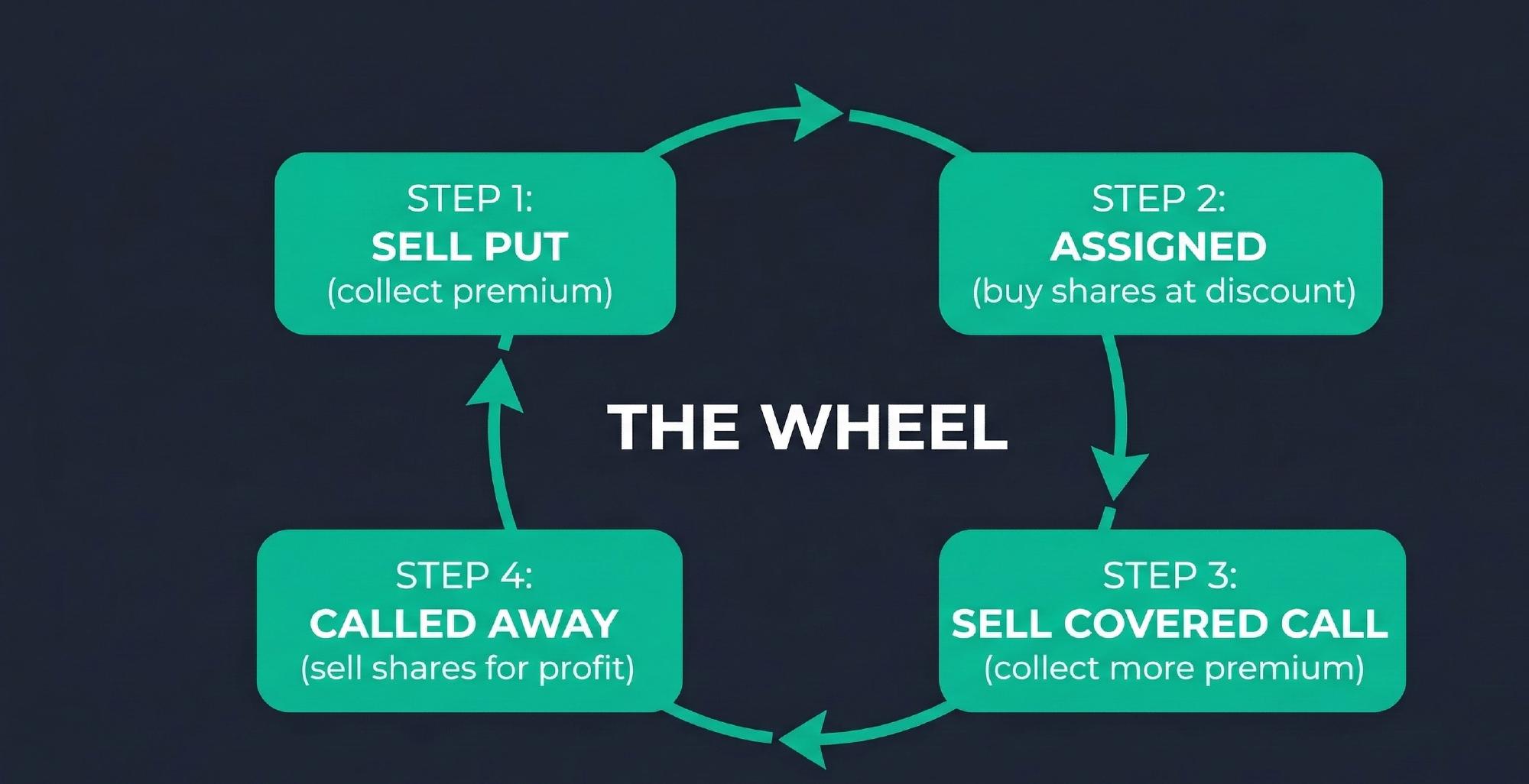
You have $5,000 in a brokerage account. You've read about the wheel strategy and it sounds perfect—sell puts, collect premium, maybe get assigned, sell calls, repeat. But every guide you find assumes a $50,000+ account. The stock picks are Apple, Amazon, Tesla. The math doesn't work when you have five grand.
I get it. I trade stocks under $25 every single day as part of my wheel strategy, and I publish every trade on this website. SOFI, RIVN, RKT, IONQ, FLY—these are real positions in my portfolio right now, and most of them require less than $5,000 in capital per position. Let me show you exactly how to get started.
How Much Capital Do You Actually Need?
Let's be honest about the numbers. Cash secured puts require you to have enough cash to buy 100 shares at the strike price. That's the math that prices most beginners out of popular stocks. But there's a whole universe of quality stocks trading under $25 that work perfectly for small accounts.
Here's the realistic breakdown:
- $2,000: Possible but limiting. You're restricted to stocks under $20 and can only run one position at a time. One bad trade and you're stuck.
- $5,000: The practical starting point. You can run 1-2 positions simultaneously on stocks in the $15-25 range. Enough room to diversify slightly and recover from a loss.
- $10,000: Comfortable. You can run 2-4 positions, properly diversify across sectors, and keep a cash reserve for opportunities.
I recommend $5,000 as the minimum for anyone serious about the wheel strategy. It gives you enough capital to trade real positions while keeping risk manageable.
Stocks I Actually Trade Under $25
This isn't a theoretical list I pulled from a screener. These are stocks I currently have wheel positions on, with real money at risk and documented results. You can see every trade I make on my results page.
SOFI (SoFi Technologies) — ~$15
SoFi is a fintech company with a banking charter, growing revenue, and increasing profitability. At around $15 per share, one contract requires roughly $1,500 in cash—perfect for a $5,000 account. The options market is liquid with tight bid-ask spreads.
My results: I've completed 8 wheel trades on SOFI. It's a stock I understand (fintech) and I'm comfortable owning at the right price.
RIVN (Rivian Automotive) — ~$15
Rivian is an EV manufacturer with high implied volatility, which means richer premiums for put sellers. At ~$15, the capital requirement is minimal. The higher volatility means you collect more premium per trade, but it also means bigger moves—size your positions accordingly.
My results: $1,019 in profit across 7 trades. RIVN has been one of my better-performing wheel positions because the high IV produces generous premiums.
RKT (Rocket Companies) — ~$15
Rocket is the mortgage and fintech giant behind Rocket Mortgage. At ~$15, it's affordable for small accounts. The stock tends to move with interest rate expectations, giving you a fundamental framework for strike selection.
My results: $820 in profit across 7 trades. Consistent performer with manageable volatility.
IONQ (IonQ) — ~$22
IonQ is a quantum computing company. Yes, it's speculative. But the options premiums are excellent because of high implied volatility. At ~$22, one contract needs about $2,200 in cash. This one requires more of your capital, so I'd wait until you're comfortable with the strategy before adding it.
My results: $1,367 in profit across 9 trades. My highest-earning small-cap wheel position. The rich premiums make up for the occasional drawdown.
FLY (Fly Leasing) — ~$24
My results: $913 in profit across 4 trades. A solid addition to a growing wheel portfolio once you have the capital.
Other Small-Account-Friendly Stocks I Trade
- UNG (Natural Gas ETF): ~$21, $289 profit from 4 trades
- RKLB (Rocket Lab): ~$15, $962 profit from 4 trades
- F (Ford): ~$10, $360 profit from 6 trades — the most affordable wheel stock
- JBLU (JetBlue): ~$6, $347 profit from 7 trades
How to Allocate a $5,000 Account
Here's exactly how I'd structure a $5,000 wheel strategy portfolio on day one:
Option A: Conservative Start (1 Position)
| Allocation | Amount | Purpose |
|---|---|---|
| 1 Wheel Position (SOFI or RKT) | $1,500 | Active put selling |
| Cash Reserve | $3,500 | Safety buffer + next opportunity |
This is how I recommend beginners start. One position, one stock you understand, with plenty of cash in reserve. Your monthly income will be modest—maybe $30-60 from one contract—but you're learning the process risk-free (relative to blowing up your account).

Option B: Moderate Start (2 Positions)
| Allocation | Amount | Purpose |
|---|---|---|
| Position 1 (SOFI or F) | $1,500 | Lower-risk wheel position |
| Position 2 (RIVN or RKT) | $1,500 | Higher-premium wheel position |
| Cash Reserve | $2,000 | Buffer + rolling capital |
Two positions across different sectors (fintech + EV/mortgage) gives you basic diversification. Monthly income potential: $60-120. Only do this if you've paper traded or already understand the mechanics.
Realistic Monthly Income Expectations
I see blog posts promising $500/month or even $1,000/month on a $5,000 account. That's not realistic and I'm not going to pretend otherwise.
Here's what you can actually expect, based on my real trading data:
| Account Size | Positions | Monthly Income | Annual Return |
|---|---|---|---|
| $2,000 | 1 | $20-50 | 12-30% |
| $5,000 | 1-2 | $50-150 | 12-36% |
| $10,000 | 2-4 | $100-300 | 12-36% |
These numbers assume 2-4% return per trade with 30-45 day cycles. Some months will be higher, some lower. You'll have losing months. My own wheel strategy generated $19,717 in 2025 across 124 trades—but I had months like April 2025 where I lost money. That's trading.
The magic happens when you compound. If you earn 2% per month on $5,000, reinvest the premiums, and add savings when you can, $5,000 becomes $10,000 faster than you'd think. Then $10,000 unlocks more stocks, more positions, and more income.
Your 90-Day Starter Plan
If I were starting the wheel strategy today with $5,000, here's exactly what I'd do:

Weeks 1-4: Learn and Paper Trade
- Read my complete wheel strategy guide
- Open a paper trading account (most brokers offer this for free)
- Paper trade cash secured puts on 2-3 of the stocks listed above
- Track every trade: entry, premium collected, outcome
- Use the free wheel options screener to practice finding setups
- Goal: Complete at least 4 paper trades
Weeks 5-8: One Real Position
- Pick ONE stock from the list above that you're most comfortable with
- Sell one cash secured put with a strike 10-15% below current price
- Choose 30-45 days to expiration
- Set a profit target: close at 50% of premium collected
- If assigned, immediately sell a covered call against your shares
- Keep the remaining $3,500 in cash—don't touch it
Weeks 9-12: Add a Second Position
- Evaluate your first month: Were you comfortable? Did you follow your rules?
- If yes, add a second stock from a different sector
- Now you're running two wheel positions with $2,000 cash reserve
- Start tracking your monthly P&L in a spreadsheet
- Review your results against mine on the results page
The Psychology of Small Account Trading
Here's what nobody tells you about trading with a small account: every loss feels enormous. When your entire account is $5,000 and you take a $300 loss, that's 6% of your capital. It feels devastating.
I've been trading for over 20 years and I still feel the sting of losses. The difference is I have rules that prevent emotional decisions:
- Never risk more than 30% of your account on a single position. With $5,000, that means your max position is $1,500 in cash secured.
- Accept that losing months happen. I lost money in April 2025. I lost money in January 2026. Both times I stuck to my process and recovered.
- Don't compare your $5,000 account to someone's $100,000 account. Percentage returns matter, not dollar amounts.
- The goal for your first 90 days is learning, not earning. If you break even and understand the strategy, you've won.
Common Mistakes Small Account Traders Make
1. Over-Concentrating
With limited capital, it's tempting to put everything into one position for maximum premium. Don't. If that stock drops 30%, you're staring at a massive drawdown with no capital to average down or trade other opportunities.
2. Chasing High Premiums
That biotech stock with 20% monthly premium looks incredible until it gaps down 40% on a clinical trial result. High premium = high risk. With a small account, one blown trade can take months to recover from. Stick to stocks you understand.
3. Ignoring the Cash Reserve
I know it feels wasteful having $2,000-3,000 sitting in cash earning nothing. But that cash is what saves you when a position moves against you. It's your rolling capital, your opportunity fund, and your emergency buffer. Don't deploy it all.
4. Selling Weeklies for "More Income"
Weekly options have faster time decay, which sounds great. But they also have much higher gamma risk—meaning stocks can blow through your strike with no time to adjust. Stick to 30-45 day expirations until you have more experience and more capital.
5. Not Having an Exit Plan
Before you enter any trade, know your exit. What will you do if the stock drops 10%? 20%? Will you roll? Take assignment? Cut the loss? Deciding in advance—when you're calm—prevents panic decisions.
Scaling Up: How $5,000 Becomes $25,000
The beautiful thing about the wheel strategy is it compounds. Here's a realistic scaling timeline:
- Months 1-6: Trade 1-2 positions, reinvest all premiums. Account grows from $5,000 to ~$5,500-6,000.
- Months 7-12: Add a third stock. Monthly income increases as your capital base grows. Account: ~$6,500-7,500.
- Year 2: You're running 3-4 positions. If you can add $200-500/month from savings, you could hit $15,000+.
- Year 3: With $15,000+, mid-priced stocks ($30-50) become available. Your income potential jumps significantly.
I'm not promising this timeline. Markets have bad years. You'll make mistakes. But the math works if you stay consistent. My own wheel strategy has generated $30,262 in documented profit across 190 trades since I started tracking on this site.
Can You Run the Wheel in an IRA?
Yes, and it's arguably the best place to do it. In a Roth IRA, your wheel income grows completely tax-free. In a traditional IRA, it's tax-deferred. Most brokers allow cash secured puts and covered calls in IRA accounts—you just can't use margin, which means all your puts must be fully cash secured anyway.
If you have $5,000 sitting in an IRA earning 4% in a money market, the wheel strategy could potentially 3-5x that return. It requires more work, but the tax-advantaged compounding is powerful.
Finding Your Next Trade
I built a free wheel options screener that helps you find trades based on your account size. You can filter by stock price, premium, and probability of profit. It's the same tool I use to scan for opportunities.
You can also follow my trades in real-time. Every position I open, adjust, or close is documented on the results page. When I sell a put on SOFI or RKT, you'll see it with the exact strike, expiration, and premium collected.
Final Thoughts
Starting the wheel strategy with $5,000 isn't just possible—it's how I'd recommend most people begin. A small account forces you to be disciplined. It forces you to pick quality stocks. It forces you to respect position sizing. These habits will serve you well as your account grows.
The Reddit threads will tell you $5,000 isn't enough. The YouTube gurus will say you need $25,000 minimum. But I'm here trading SOFI, RIVN, RKT, and IONQ right now with positions that require $1,500-$5,000 in capital each. The strategy works at this level. I have the trades to prove it.
Start small. Stay consistent. Let the premiums compound. And when you're ready to accelerate your learning, join me in the course where I teach the complete system with real-time trade alerts.
— Spicer
Ready to learn options trading?
Start learning how to successfully trade options to earn monthly income.
Related Topics: Wheel Strategy Small Account, Options Trading With $5000, Wheel Strategy Beginners, Small Account Options Trading, Wheel Strategy, Selling Puts for Income, Options Income Small Account, Beginner Options Trading, Cash Secured Puts Small Account, Covered Calls Beginners